I
A poem may be made illegible not only by neglecting its language, but also by deciding in advance what its language is to conjure into the light of the world. The first form of blindness overlooks the word; the second sees only what it has already decided to find there. Between them lies the possibility that something should come into view for which neither the world as we know it nor the concepts through which we grasp it have yet made room.
Góngora’s Fable of Polyphemus and Galatea opens precisely this possibility. Its mythological figures cannot be exhausted by the moral categories, any more than its language can be reduced to the representation of a world already constituted.
II
Polyphemus is not merely a monster who desires a woman who, in turn, does not desire him. He belongs to a more ancient and disquieting universe of refereence.
In Homer, he is the son of Poseidon. His world is one in which distance, mediation and reciprocity scarcely find a place. His single eye lacks perspective, his strength is immediate, his gestures abrupt. He eats, seizes, crushes. The verbs fall like blows, one after another. Odysseus, by contrast, survives through the art of delay, indirection, disguise and calculated distance.
This difference concerns two ways of inhabiting the world: through immediate incorporation, which admits no exteriority, and through the interval in which something other than oneself may appear.
III
Similarly, in the myth of Polyphemus and Galatea the decisive distinction is between correspondence and appropriation. Galatea loves Acis and Polyphemus cannot make his desire reciprocated by the sheer force of desiring. His tragedy lies not simply in being refused, but in the impossibility of turning desire into possession without destroying the very relation he seeks. He wishes to abolish the distance that separates him from what he desires, but that distance is what allows the other to exist beyond him. When he crushes Acis, he does not overcome separation. He transforms it into irreparable loss.
Yet Acis becomes a river. The violence does not restore the world to the Cyclops’s immediate grasp. What it destroys returns in another form, flowing beyond the reach of that grasp. The metamorphosis does not cancel the violence or compensate for it; it opens, in the aftermath of destruction, a mode of existence that possession can neither command nor arrest.
The sense of the myth therefore resides in what happens between the three characters and in what happens when Polyphemus attempts to abolish the distance between himself and Galatea as the object of his desire.
IV
Góngora’s fable, however, does not simply retell a myth whose meaning has already been established. The poem makes the myth appear otherwise. Its language is no transparent vehicle for characters, actions or ideas, but the very medium in which a world comes into being.
From the Sicilian sea and the volcanic traces of Typhon to the cavernous darkness that shelters Polyphemus, landscape emerges through successive transformations. Metaphor does not adorn a world already constituted: it unsettles the apparent identity of things, allowing one thing to disclose itself through another without becoming identical to it. The world comes into view where its contours cease to be self-evident.
Here lies the extraordinary force of Góngora’s poetry. Its difficulty conceals no simpler message beneath the surface. Syntax delays recognition; metaphor multiplies perspectives; sound draws things into relations that paraphrase cannot capture. The world becomes visible in a splendour that belongs neither to the thing alone nor to the word alone, but to their encounter.
V
To read Góngora as the symptom of a melancholic masculine poetics—briefly, to identify his voice as Polyphemus’s—is to lose sight of all this. It amounts to silencing his poetry. It implies turning myth into a case and the poem into evidence. What this miserably erases, then, is the very thing that makes the poem extraordinary: the movement of language through which the world ceases to be merely what it was. Yet true poetry is always auroral in this sense. It does not simply illuminate what is already there; it lets the world emerge anew, at the threshold where word and world become distinguishable without becoming separable.
VI
To read Góngora as the symptom of a melancholic masculine poetics—briefly, to identify his poetic voice with Polyphemus’s—is to lose sight of all this. It amounts to silencing his poetry. It implies turning myth into a case and the poem into evidence.
What this miserably erases, then, is the very thing that makes the poem extraordinary: the movement of language through which the world ceases to be merely what it was. Yet true poetry is always auroral in this sense. It does not simply illuminate what is already there; it lets the world emerge anew, at the threshold where word and world become distinguishable without becoming separable.
This is not to deny that Polyphemus may be more than a figure of pure negativity. He is also the lover who desires what he cannot possess, who can even recognize, in the beauty that eludes him, something irreducible to his desire. Such recognition does not undo the tragedy, but it complicates Polyphemus’s figure, who thereby becomes someone exposed, however obscurely, to the distance that desire both opens and suffers. Yet in his melancholy would not necessarily lie then in a supposedly embittered masculine identity as much in the painful yet essential discovery that life cannot be exhausted by possession, correspondence or fulfilment.
For melancholy is not a pathology from which life must be rescued, nor a posture to be worn as an identity. It belongs to life itself, as does the distance between what we desire and what the world allows us to attain. A world without this distance would have no need of desire, but neither would it leave room for anything to appear beyond ourselves. To acknowledge melancholy is not to glorify suffering; it is to refuse the impoverished notion that life becomes worthwhile only when its losses can be overcome and its desires fulfilled.
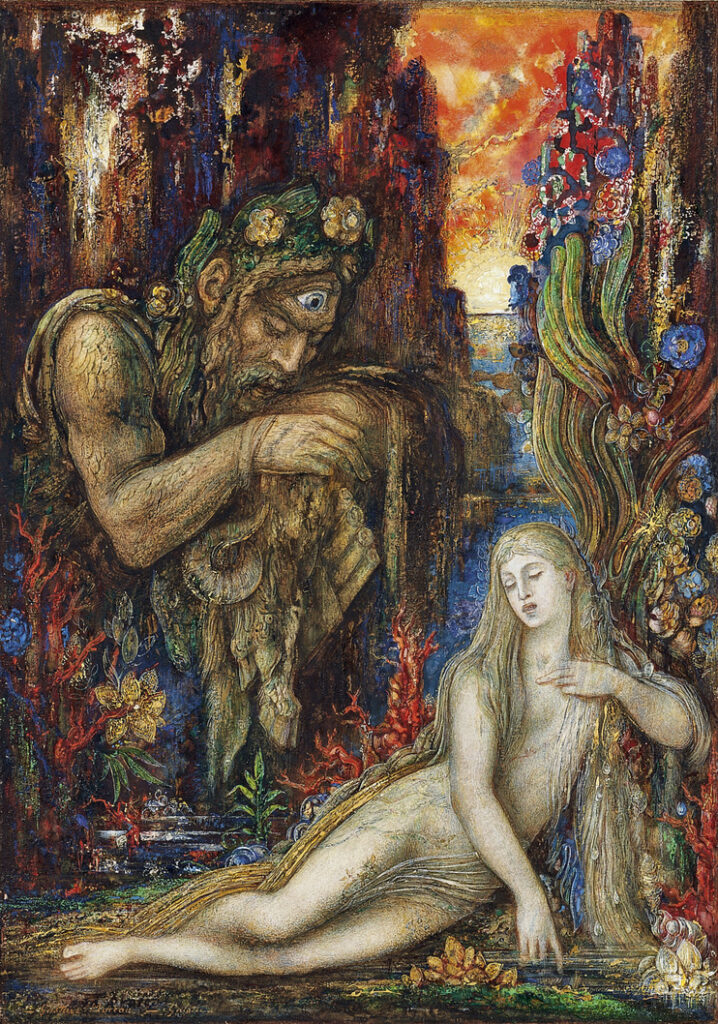
Gustave Moreau, Galatea (c. 1896) (Thyssen Bornemisza Museum, Madrid)