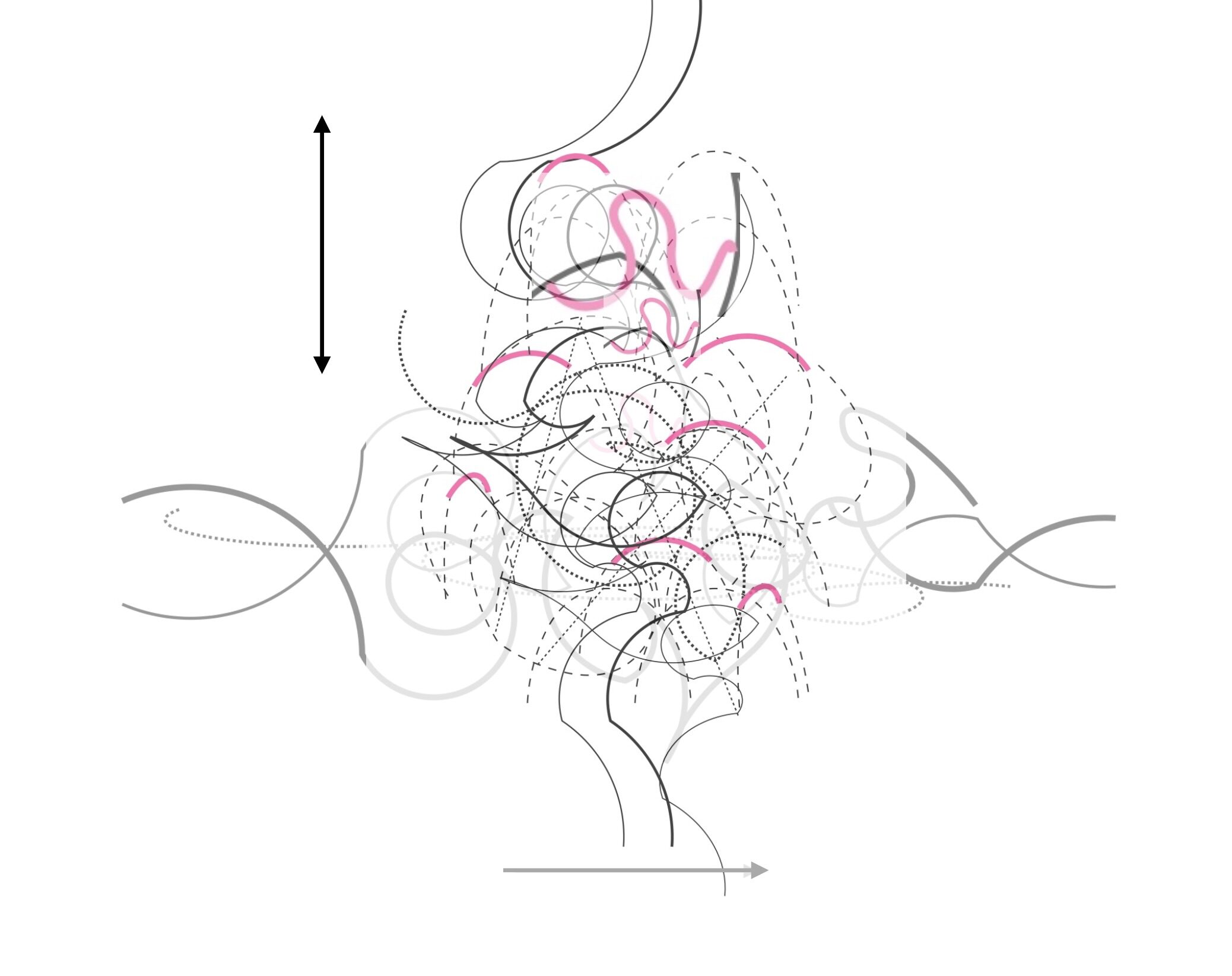
Deleuze writes that “[a] close-up does not tear away its object from a set […] of which it would be a part, but on the contrary it abstracts it from all spatio-temporal co-ordinates, that is to say it raises it to the state of Entity.”(⊕) Think e.g. on the close-up of a face, which are,…
Author: polymorph
The Enigma of the Sensible
Commenting on Stendhal’s The Red and the Black, Maurice Merleau-Ponty writes: What is important is not that Julien Sorel [i.e. the protagonist], after he has learned that he has been betrayed by Madame de Rénal, travels to Verrière and tries to kill her. It is that silence, that dreamlike journey, that thoughtless certainty, and that…
Untimely Notes on Time
§1 • What is present cannot become past after being present, for that would mean it becomes past in the future. Rather, the present, any present, must be always passing, or, more exactly, given its thinness or inherently-ephemeral nature (the present never lasts long), it must unceasingly and simultaneously bifurcate itself in two directions (like…
Two Types of Outside: Vermeer & Velázquez
Allow us to begin by quoting two Wittgensteinian propositions and an excerpt from Roy Wagner’s comments on them in his The Logic of Invention (2019). Wittgenstein: “A picture cannot […] depict its pictorial form: it displays it” (Tractatus, 2.172). “A picture cannot […] place itself outside its representational form” (ibid., 2.174) Wagner: “A picture does…
10 – 3 ≠ 7; 10 – 3 = 13
Should we have learned indigenous mathematics or, more exactly, should we remember them – for we were all once indigenous peoples – the world would be different and probably better than it is today. For the ontology behind modern mathematics and, more broadly, modern science, is anything but neutral. Put differently, reality is not just…
More on Chaos, Rhythm, and Forms
We have written elsewhere on schizophrenia, following Jean Oury, as a “rhythmic distortion.” We would now like to add that such distortion is neither what one presences when one witnesses a schizophrenic delirium nor what one enters when one enters one. For, as Freud stresses, it is at re-building their collapsed worlds that psychotics aim…
When Binary Thought is Not What you Think
A Primal Evolutionary Phenomenon and a Recurrent Social-Cultural Constituent “It is a singular property of the human species,” writes Leroi-Gourhan, “that by confining itself to engendering action, it periodically eludes the organic specialization that would definitively tie it down. If the hand of the earliest anthropoid had become a tool by adaptation, the result would…
What Is Philosophy?
Introduction We have written elsewhere that philosophy is about reflecting on how we see things when we see them through such or such ideas, and about reflecting on which ideas allow us to see things in a more rich and complex way. It is also – we would now like to add – about producing…
Derrida’s Mistake – or, Why One Should Never Philosophise on the Origins of Things According to What Happens at One’s Home
I In Of Grammatology, Derrida rejects Lévi-Strauss’s account of his encounter with the Nambikwara as naif. Lévi-Strauss, says Derrida, is a victim of the typical Rousseauian nostalgia before an allegedly-egalitarian-and-transparent society in which any attempt on the part of one of its members to concentrate power and turn opaque its transparency is punished by the…
If God Loves You, It Means He Is Your Enemy: On Savage Thought and Christian Non-Sense
I. On Different Types of Oneness – and Their Danger Christian universalism is epitomised in these two passages extracted from two of Paul’s letters: “There is no longer Jew or Greek, there is no longer slave or free, there is no longer male and female; for all of you are one in Christ Jesus” (Gal…