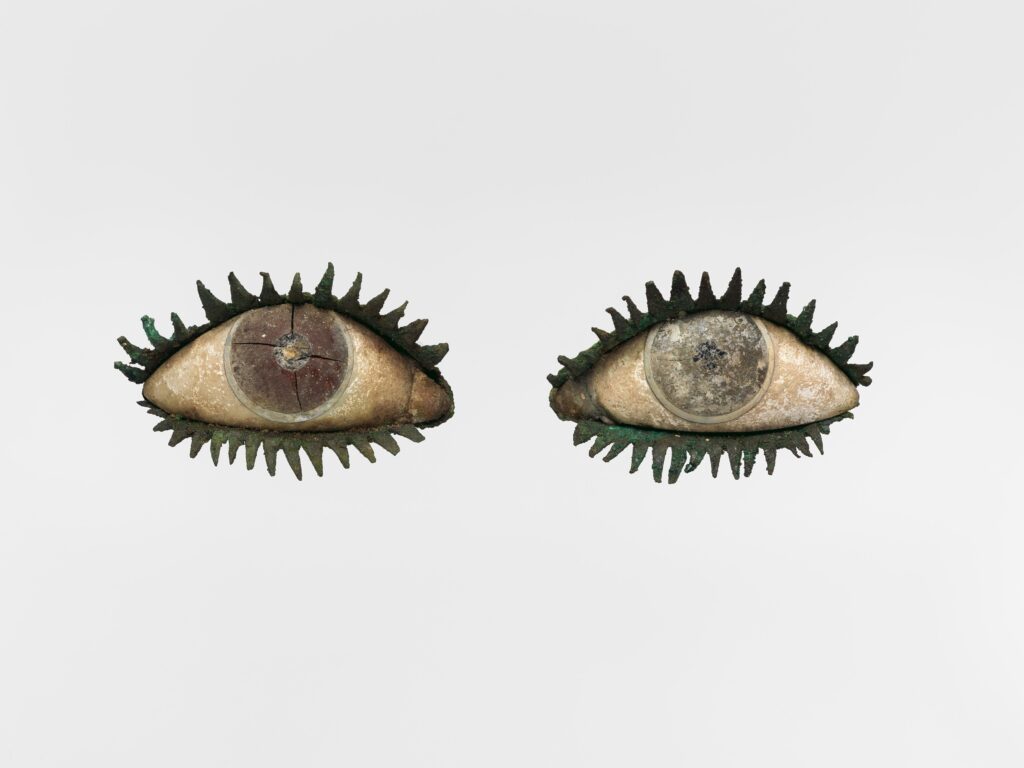
Ancient Greek pair of eyes made of bronze, marble, frit, quartz, and obsidian. 5th century BCE or Later.
Metropolitan Museum, New York. Object 1991.11.3a, b
I
A fresh look at Greek mythology requires perhaps that we view its gods (θεοί) both as those who offer us a deeper “insight” into things – for with just a slight change in the accent, the word θεά (“goddess”) becomes θέα (“sight”) – and as “those who look at us” (θεάοντες) and make us visible. Our gaze and theirs thus entwine, shimmering into iridescence.
But what exactly does this mean?
Take the opening verses of Pindar’s sixth Nemean ode, to which I have referred elsewhere:
ἓν ἀνδρῶν, ἓν θεῶν γένος· ἐκ μιᾶς δὲ πνέομεν
ματρὸς ἀμφότεροι· διείργει δὲ πᾶσα κεκριμένα
δύναμις, ὡς τὸ μὲν οὐδέν, ὁ δὲ χάλκεος ἀσφαλὲς αἰὲν ἕδος
μένει οὐρανός. ἀλλά τι προσφέρομεν ἔμπαν ἢ μέγαν
νόον ἤτοι φύσιν ἀθανάτοις,
καίπερ ἐφαμερίαν οὐκ εἰδότες οὐδὲ μετὰ νύκτας ἄμμε πότμος
οἵαν τιν᾽ ἔγραψε δραμεῖν ποτὶ στάθμαν.
My own translation:
One is the race of men and gods:
from one mother we both draw our breath.
But our different powers set us aside,
for we are nothing, while the bronzed heaven remains ever secure in place.
And yet in something we come close to the immortals,
to wit, in [our] great [in]sight (νοῦς) and [our] shining forth (φύσις);
although we ignore by day or night which is our lot,
what finishing line we are running to.
Translating νοῦς by “thought” and φύσις by “nature” (v. 5) is also possible, but it loses the essential, namely, that it is through the gods that we see when we do see what’s there before us and within us, for the gods are the ever–living – the eternally recurring – forces which make and unmake the worlds we live in – worlds whose configuration is, as Clémence Ramnoux stresses, not decided beforehand insofar as we, mortals, inhabit an unstable domain of reality which belongs, in rigour, to no-one: its neither Zeus’s, nor Poseidon’s, nor Hades’s – for Zeus claims the heavens, Poseidon the surging seas, and Hades the shadowed underworld.<1> Hence, we must try and see through what appears to be – be it before or within us – and find out what forces are at stake in the game each time; in other words: we ought to decipher reality’s permanent and dynamic disequilibrium, our own life being at risk if we fail to do so.
This is also the reason why one should neither infer a certain wisdom (as though the world’s furniture were always the same), nor a technique (as though we could manipulate it), let alone a path to salvation (as though this life could be replaced by another one) from Greek mythology, but a constant invitation to unravel reality’s infinite riddles: a pragmatics, if you will, at whose heart lies reality’s Sphinx-like nature, that is, reality’s manyfold enigma. And it is also the reason why one of the main centres of is only improperly called Greek “religion” – improperly because the latter is strictly “pre-religious,” if with Carlin Barton and Daniel Boyarin one concedes that “religion” is a Christian phenomenon through and through,<2> somehow prefigured but nothing more, one may perhaps add, by Judaism, and later reworked by Islam – was Apollo’s Delphic oracle, where, as Plutarch underlines, thought analysis played a crucial role.
Besides, in times like ours of dogmatism and nihilism, such an invitation proves all the more timely.
But let’s go back to the correlation in them between νοῦς and φύσις, sight and exposure, seeing (what there is) and being seen (in relation to it, since we are part of it). The almost endless game through which they shift into one another can be said to come to an end for each of us when we die – in the sense, too, that Pasolini said that death gives final, i.e., definite and definitive, shape to what we struggle to become. Therefore, if we do not perceive the game, if we do not gain insight into it, we miss both what things are and what we ourselves can become vis-à-vis them; in other words, we renounce to play a conscious part in, we refuse to make any choices, we decline to throw our dices (and so ἀνάγκη, blind “necessity,” gains the upper hand). Conversely, if we do, if we succeed in deciphering the game, there is a chance – if only that! – that we may gain “figure” (ψυχή) and do something memorable before we are dragged away from the board.
This – rather than any form of political elitism, I dare say – explains Heraclitus’s frag. DK B29 (again, my own translation):
αἱρεῦνται γὰρ ἒν ἀντὶ ἀπάντων οἱ ἄριστοι, κλέος ἀέναον θνητῶν· οἱ δὲ πολλοὶ κεκόρηνται ὄκωσπερ κτήνεα
One thing alone do the best chose: the ever-lasting fame of mortals, while the others are satiated, like cattle.
Interestingly moreover – as I have briefly examined here as well – Heraclitus’s frag. DK B62 depicts in (double) chiastic terms (i.e., as an X; or, more precisely, as a double X) what Pindar portrays in a zigzagging (or Z-like) manner (my translation once more):
ἀθάνατοι θνητοί, θνητοὶ ἀθάντατοι, ζῶντες τὸν ἐκείνων θάνατον, τὸν δὲ ἐκείνων βίον τεθνεῶτες
Immortal mortals, mortal immortals: living each others’ death, dying each others’ life.
II
Again then: the gods offer us a deeper insight into things and make us visible – both.
Put otherwise – and moving now from the visual to the acoustic, and more the point musical, domain: the divine and the human interplay as the different voices in a polyphonic composition, thereby resonating at different heights. Figure out the harmony first, only then you might change the rhythm and produce a melody! This would be the guideline; in contrast, let me quickly add it, to the way in which the divine, in the monotheistic religions, remains at an initially incommensurable distance from the human which is only bridged (in fact dissolved, and with it the divine as such, I fear) in rather tawdry theatrical terms by turning the God in question into a sort of deus ex machina.
Anyway, there is perhaps no better example of that polyphonic interplay that the fifth song of the Iliad: Diomedes’s aristeia.
Note especially the following lines (vv. 1–8, 85–105, 114–32, 330–46), in Peter Green’s translation:<3>
Now on Tydeus’s son Diomēdēs Pallas Athēnē bestowed
power [μένος] and courage [θάρσος], that he might be clearly preeminent [ἔκδηλος]
among all the Argives, and gather illustrious renown [κλέος]
From his helmet and shield she made blaze an unwearying flame
like that star of the harvest season that shines out most intensely | 5
after dipping in Ocean’s stream: of such a nature
was the light that she made to gleam from his head and shoulders
and she thrust him into the center, where the struggle was greatest.
[…]
[…] you could not tell which side he was fighting on—was | 85
he with the Trojans or the Achaians?—
so wildly he ranged the plain, like some swollen winter torrent
that, rushing onward, sweeps away dikes unable,
however close-packed, to hold back its raging progress,
nor can its sudden coming be stopped by the flourishing vineyard’s | 90
walls, when a Zeus-sent rainstorm augments its waters,
and many good man-made works collapse before it. Just so
before Tydeus’s son’s advance the massed Trojan battalions
were routed, not standing to face him, despite their numbers.
When Lykaōn’s fine son Pandaros caught sight of him storming | 95
across the plain, and driving those battalions before him, at once
against Tydeus’s son he bent his curved bow, aimed true,
and hit him in the right shoulder as he pressed on forward,
on the plate of his corselet: clean through winged the bitter shaft ,
piercing the flesh, and the corselet was blood-bespattered. Then | 100
over him loud exulted Lykaōn’s fine son: “Rouse up now,
all you high-spirited Trojans, you spurrers of horses! The best
warrior of the Achaians [ἄριστος Ἀχαιῶν] is hit, and he won’t, I assure you,
long survive my strong missile, if it’s true it was Lord Apollo,
Zeus’s son, who encouraged me to come here from Lycia.” | 105
[…]
Then Diomēdēs, good at the war cry, made this prayer:
“Hear me, unwearying child of Zeus of the aegis! | 115
If ever with kindly heart you stood beside my father
in the madness of battle, now befriend me too, Athēnē [νῦν αὖτʼ ἐμὲ φῖλαι Ἀθήνη]!
Let me take down this man, let him come within my spear cast,
whose shot caught me unawares, who now boasts over me, who
swears that not for much longer shall I look on the sun’s bright light.” | 120
So he spoke in prayer, and Pallas Athēnē heard him.
She made his limbs buoyant [ἐλαφρά], his legs and the arms above them,
and standing close by his side spoke to him winged words:
“Take heart now, Diomēdēs, for your battle against the Trojans,
for in your breast I have set your father’s dauntless fury— | 125
such as he had, he, the horseman, Tydeus the shield wielder;
and the mist that was over your eyes I have taken away
to let you clearly distinguish a god from a mortal [ὄφρʼ εὖ γιγνώσκῃς ἠμὲν θεὸν ἠδὲ
καὶ ἄνδρα.]. So now
if some god comes here to make trial of you, no way
are you to meet in battle any one of the other immortals | 130
save Aphrodītē alone, Zeus’s daughter. But if she enters
the fighting, her you may wound with your keen-edged bronze.”
[…]
[…] [Diomēdēs] had taken his pitiless bronze | 330
in pursuit of Kypris [= Aphrodītē], aware what a weakling goddess she was—
not the kind who lords it in a battle of warriors,
no Athēnē she, for sure, no Enyo, sacker of cities!
Now, when he overtook her in his chase through the crowded ranks,
he sprang at her, did high-spirited Tydeus’s son, and lunged, | 335
and sliced into the flesh of her hand with his keen-edged bronze—
that delicate hand! The spear drove straight into her flesh—
clean through the fragrant robe toiled on by the Graces themselves—
at the base of her palm: out flowed the goddess’s blood, immortal
ichōr [ἰχώρ], such as flows in the veins of the blessed gods, | 340
for they neither eat bread nor drink fire-bright wine, and so
are bloodless [ἀναίμονες], and come thus to be called immortals.
She screamed aloud, and let her son fall, but Phoibos
Apollo gathered him up in his arms and kept him safe
in a dark cloud, lest one of the swift-horsed Danaäns | 345
might flight bronze into his breast and rob him of life.
Not only does Athena bestow (on v. 2) μένος and θάρσος upon Diomedes (from Διός + μήδομαι, “capable of measuring the divine”), so that he shines forth and becomes fully “visible” (ἔκδηλος). The goddess “of clear eyes\sight” (γλαυκῶπις Ἀθήνη) grants him insight – for she is but that insight personalized! – so that he becomes able to “discern” (which is the meaning of the verb γιγνώσκω) the divine in (i.e., traversing a given) human form; literally, she says (at v. 128), “so that you [may] properly discern both god and also [sic!] men” (ὄφρʼ εὖ γιγνώσκῃς ἠμὲν θεὸν ἠδὲ καὶ ἄνδρα), that is to say, the specific god (or goddess in this case: Aphrodite) that abides in a specific man (Aeneas). For it is not that Aphrodite as a divine individual protects Aeneas as a human individual, since (unlike the Christian God) the Greek gods are not individuals of a different, supernatural, kind: it is that Aphrodite shines forth through Aeneas, or better, that Aeneas’s shining forth is beautiful.
Hence, contrarily to how v. 128 is commonly translated: “so that you can discern god from man,” I take the discernment propitiated by Athena to be the discernment of the immortal within the mortal (in consonance with Heraclitus’s frag. DK B62). Philologically speaking, on the other hand, the Greek construction ἠμὲν… ἠδὲ… (“both… and…”), on which tellingly Kirk remains silent,<4> need not be interpreted as an “either… or…” construction (A or B). It can also be interpreted, as I am proposing here and quite naturally indeed, in inclusive terms (A and B, i.e., A as B and B as A). Plus, the double conjunction: ἠδὲ καὶ (“and also”) serves to emphasize the inclusion.
In a nutshell: only by assuming beforehand that gods and humans represent two different types of individuals – a tacit Christian assumption – can one fancy that Athena makes possible for Diomedes to distinguish between both, i.e., to discern one from the other; or that the scene we – actually you, reader (v. 85) – are here confronted with, a scene that ends with Aphrodite being wounded by Diomedes (vv. 330ff.), parallels, say, Gilgamesh’s personal rejection of Ishtar’s personal amorous advances towards him, on Tablet VI, ll. 1–91, of the Babylonian epic.<5> At most, Diomedes is enabled to discover, and in that sense he is enabled to discern (to decipher), the divine (Aphrodite) (hidden) within the human (Aeneas); and thanks to it he is able to wound the hand of the goddess when attacking beautiful Aeneas.<6>
This is what makes Diomedes “excellent” (ἄριστος) (v. 103). And this, too, is what makes him “light,” that is, agile (v. 122), and thus elective to achieve mortal “glory” (v. 3) – a glory the gods do not need, since they are immortal. Now, because they are immortal, they can recur, they do recur: they return once and again, as we learn in vv. 116–17, 125–6, where Diomedes asks Athena to befriend him as she had formerly befriend his father.
III
Mythology was not a pastime for the Greeks – it was not their Netflix.
Nor was it a collection of inoffensive allegories (like the one expressly introduced as such in v. 87).
Aphrodite, like any other goddess or god, can be wounded. For the gods offer us insight into the reality they give shape to. And it is before their eyes, then, that we, too, become visible. Our gaze and theirs thus entwine, shimmering into iridescence… and our skins touch and graze.<7>
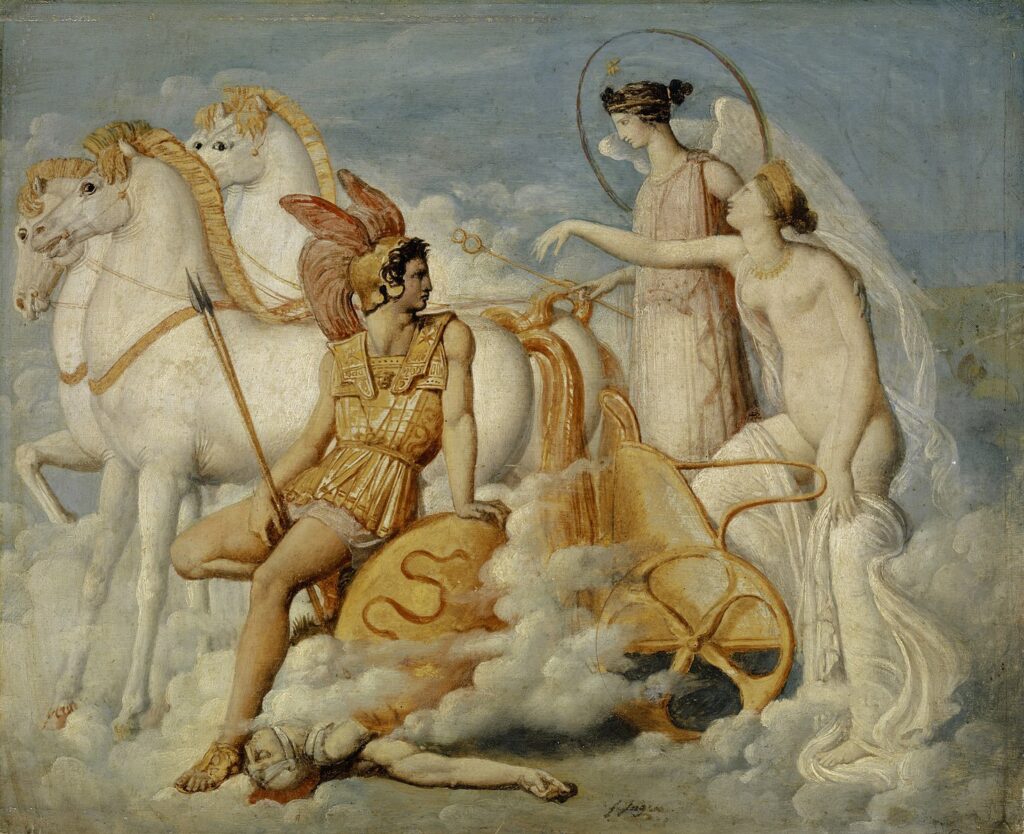
Jean Auguste Dominique Ingres: Venus, Injured by Diomedes, Returns to Olympus (c. 1803)
Kunstmuseum Basel, Switzerland
———
<1> Clémence Ramnoux, Œuvres (Paris: Les Belles Lettres/encre marin, 2020), tome I, 629–32.
<2> Carlin A. Barton & Daniel Boyarin, Imagine No Religion: How Modern Abstractions Hide Ancient Realities (New York: Fordham University Press, 2016).
<3> The Iliad. A New Translation by Peter Green (Berkeley, Los Angeles & London: University of California Press, 2015).
<4> G. S. Kirk (ed.), The Iliad: A Commentary (Cambridge & New York: Cambridge University Press, 1990), vol. 2, p. 69.
<5> M. L. West, The Making of the Iliad: Disquisition and Analytical Commentary (Oxford & New York: Oxford University Press, 2011), p. 158.
<6> That is to say, Aphrodite shines forth through Aeneas and before his eyes. No blood comes out of her hand, though, but ἰχώρ, an ethereal fluid in accordance with the gods’ Ambrosian, and thus likewise ethereal, nurture; for unlike us, the gods neither eat bread nor drink wine (vv. 339–42) – compare with the Christian God, who, lowered to a human status, transforms into bread and wine. Back to Aphrodite’s theophany: it is her appearing before Diomedes’s eyes what turns her into a person, Greek πρόσωπον (from πρό + ὤψ: that which appears “before our eyes”), which (therefore) does not have here the common modern meaning of a “subject” or “individual,” even if (like any other goddess or god) she obviously appears as someone in addition to appearing as something. I am grateful to Edward Butler (personal communication of May 24, 2025) for pointing to me that the term “person” need not be a priori discarded when dealing with the Greek goods, to avoid turning them into mere characters. See further Butler, “Polytheism and Ecology” (Indica Today, May 27, 2027), as well as Viveiros de Castro’s take (in, e.g., The Relative Native [Chicago HAU Books, 2015], p. 245) on prosopomorphism.
<7> They only completely withdraw from us when we die, as Artemis does with Hippolytus when Poseidon’s horses make him fall.