“Searching (for) limits” beyond those previously assigned and “getting rid of the glue” that held everything together in organic fashion: these are the expressions Richard Taruskin employs to characterize two distinct, though broadly contemporaneous, aesthetic responses within post-Wagnerian European music. The first, associated with the German tradition of Mahler, Strauss, and ultimately Schoenberg, sought to push inherited musical premises to their breaking point; (1) the second, represented by Satie, Debussy, Fauré, and Ravel, worked instead to loosen the connective tissue of tonal architecture without entirely abandoning it.(2) Stravinsky’s early primitivism stood apart from both tendencies; yet, as Taruskin observes, it intersected most sharply with Schoenberg’s project:
“If Stravinsky was writing the music of the present […], then why, Schoenberg wanted to know, did Stravinsky look to the even more distant past for models? […] Stravinsky was trying to turn back the clock on the development of music, substituting restoration for the progress it was every artist’s obligation to advance.”(3)
For Schoenberg, advancing music meant, above all, abolishing the hierarchy that governed tonal relations. His aim was not to abandon the language of pitch altogether—as Varèse would later attempt by extending musical thought beyond pitch organization itself—but to undermine tonality from within, forcing its internal logic to collapse under its own weight. Against such a program, the impressionistic strategy of “getting rid of the glue” appeared insufficiently radical. The issue was not merely to fragment tonal architecture through new colours, textures, or ambiguities; it was to furnish the music of the present—and, more importantly, of the future—with a fundamentally non-hierarchical organization of pitch. To borrow a contemporary philosophical idiom, Schoenberg’s gesture can be understood as the construction of a musical flat ontology, one in which all twelve tones of the chromatic scale are granted equal ontological dignity.
What often disappears when this narrative is told—and it could, of course, be told otherwise, depending on whether one adopts the perspective of Debussy, Stravinsky, Varèse, or any number of others—is the existence of an exterior to the narrative itself: a musical domain situated at equal distance from all of its available alternatives. This exterior concerns the fact that an entire musical continent—not vast in temporal or geographical terms, perhaps, but precious enough to justify neglect—remained largely foreign to the developmental sequence upon which the narrative depends. That sequence may be schematically described as follows: (i) the systematization of tonal relations > (ii) the hierarchical integration of the resulting material into organic wholes > (iii) the crisis of that architecture and > (iv) the subsequent exploration of various escape routes from it—impressionism, primitivism, atonality, twelve-tone composition, the dissolution of distinctions between music and noise, electronic music, aleatory procedures, and so forth.
A hidden musical continent, then? Precisely. Yet in those histories cautious enough to acknowledge its existence, it is usually reduced to the status of a “style”—a local technique, an ornamental practice, a minor episode. And a style it certainly is. It was originally called style brisé: the “broken style.” Yet it is also something more. For it implies an altogether different concept of music. Occupying the margins of the narrative outlined above, it can find no proper place within it. It persists instead as a remainder, a specter, a forgotten possibility that continues to haunt the story of modern music from within its margins.
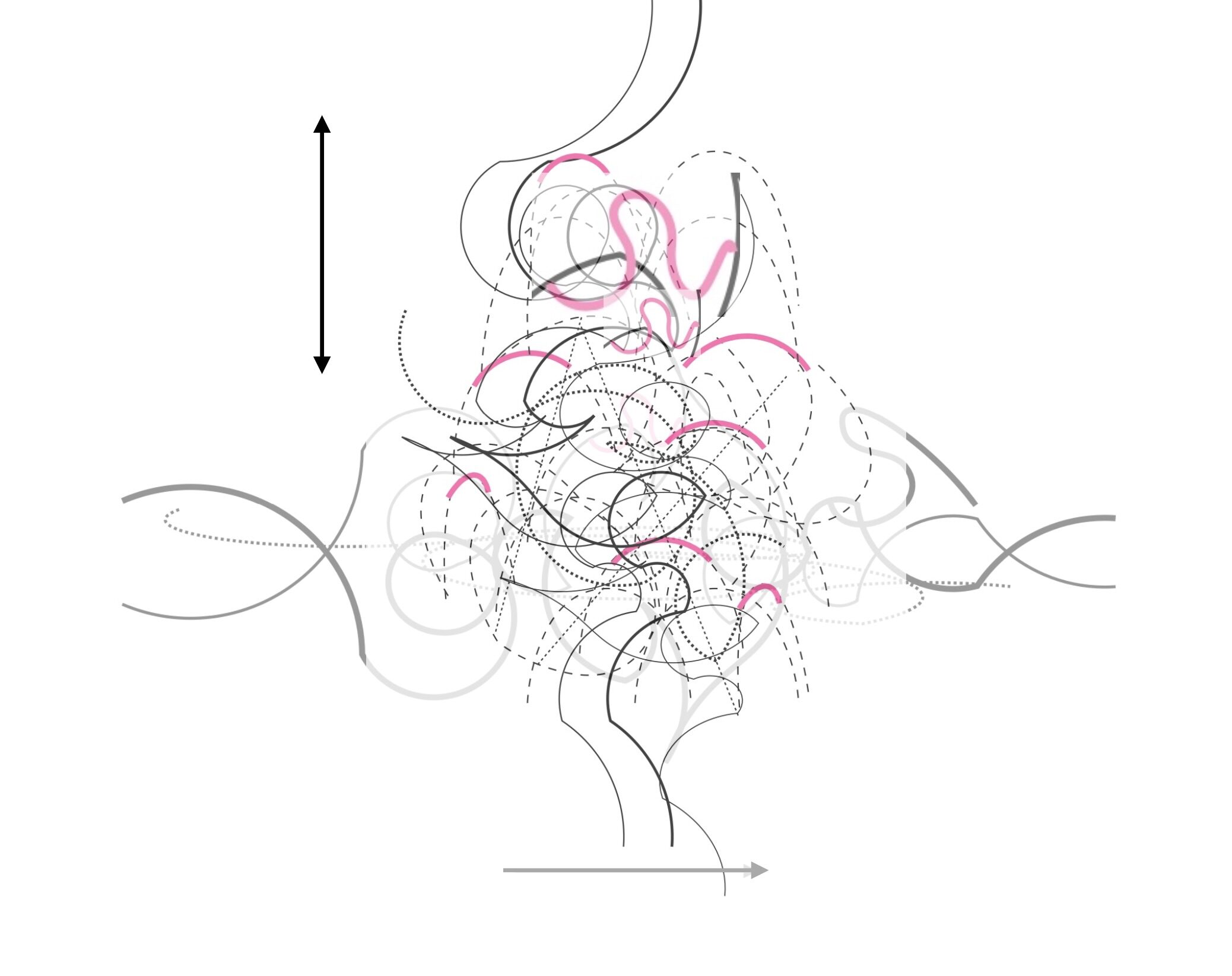
Style brisé is associated primarily with the French lute tradition of the 17th century, and with its influence on the French Baroque repertories for viola da gamba and harpsichord. In this practice, the principal voices—melody, inner parts, and bass—are not presented as continuous lines but are dispersed into a network of echoes, delays, refractions, and interruptions. Their apparent unity is dissolved into a succession of local events, compromising the very notion of an organically integrated musical totality. Music becomes spectral in a rigorous sense: not because it abandons structure, but because structure manifests itself only through traces, resonances, and absences.(4)
The same principle extends to the level of the individual note. Rather than functioning as a stable point within a larger figure, each note unfolds as a constellation of micro-events: attack, resonance, fragmentation, decay, recollection. Even the notation itself—the lute tablature—reflects this evental logic. Viewed from within the parameters of the dominant narrative, such procedures can appear merely ornamental, little more than ingenious solutions to the technical limitations of plucked-string instruments such as the lute or theorbo, whose sounds begin disappearing at the very moment they are produced. Yet this interpretation mistakes a consequence for a principle. The fading sonority of the instrument does not constrain its musical possibilities but reveals the ontology upon which these rest. Here musical substance is never given as a stable presence but only as a transient apparition. Sound emerges already on the threshold of its own disappearance.
Style brisé is thus not merely a forgotten antecedent to modernity but its spectral double: a musical world in which unity never precedes fragmentation, because fragmentation is primary. Long before the crisis of tonality, it had already suspended the dream of organic totality. What modernism would later seek through rupture, negation, or systematic dissolution, style brisé had quietly inhabited as a positive condition. Its broken voices, fading resonances, and dispersed events disclose another lineage for the modern ear—one that does not emerge from the collapse of order but from the recognition that order was never there to begin with. In this sense, style brisé haunts modernity—allow me to insist on it—as its musical ghost: neither ancestor nor alternative, but the forgotten outside that renders its founding narrative incomplete.
(Listen here on Spotify, by way of illustration, to a Prélude in D Minor by Ennemond Gaultier, performed by Hopkinson Smith.)
Notes
(1) Richard Taruskin, The Oxford History of Western Music (Oxford and New York: Oxford University Press, 2010), vol. 4, pp. 1–58.
(2) Ibid., pp. 59–129.
(3) Ibid., p. 678.
(4) Cf. the definition provided by The Harvard Dictionary of Music (ed. D. M. Randel; 4th ed.; Cambridge, MA, and London: The Belknap Press of Harvard University Press, 2003), p. 847: “Style brisé [Fr. broken style]. A texture in which melodic lines are subservient to the broken chords and composite rhythms they create. Voices merge and change roles frequently, and even melody notes are delayed […]” (emphasis added). Notice, however, that all this is described as constituting merely a musical “texture.”

Georges de La Tour, The Finding of St Sebastian (1649). Berlin, Gemäldegalerie