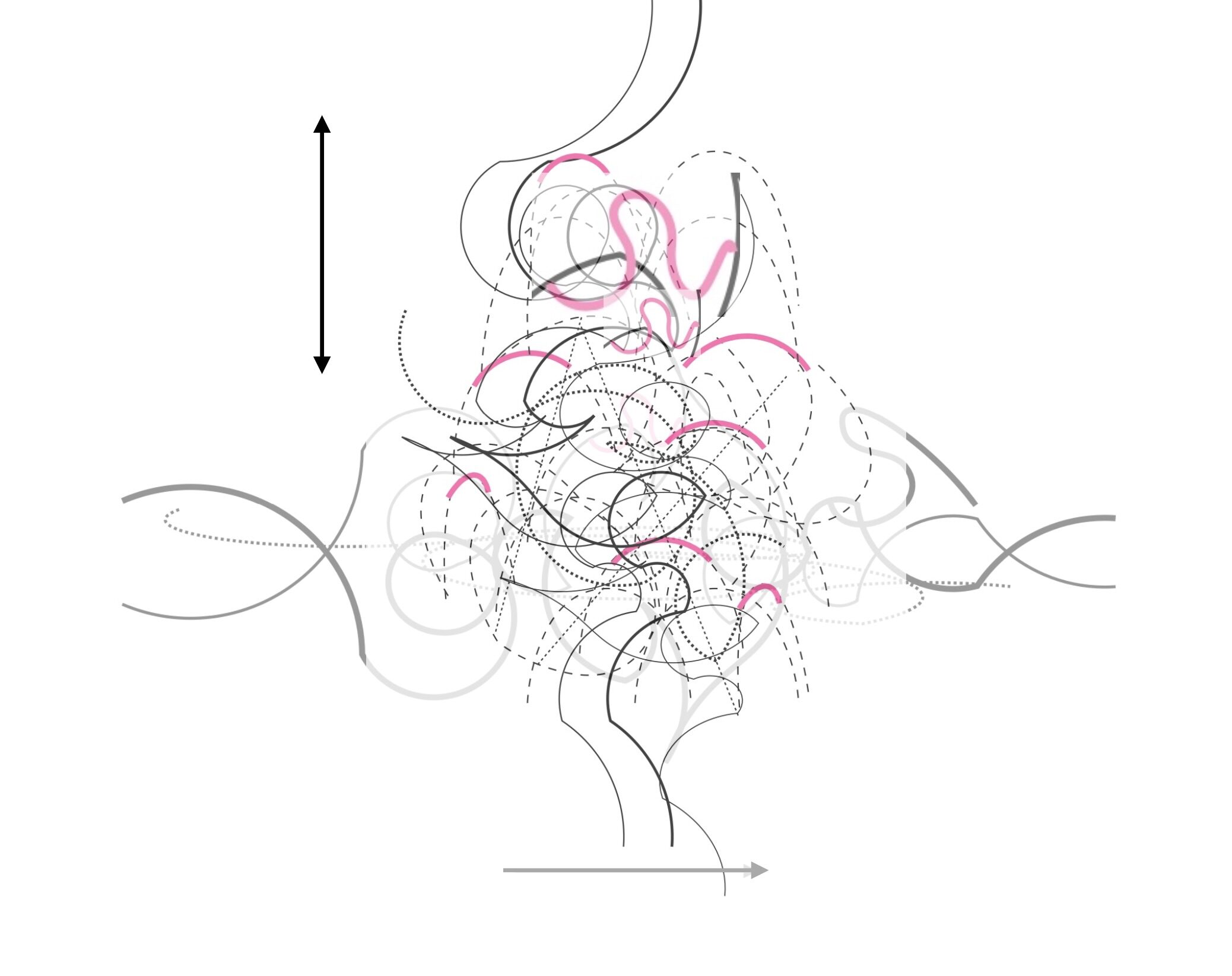
A diagram is not merely a way to illustrate something. It is rather the transformation of “content” into “form.” It therefore involves a recoding, e.g., the recoding of an idea in visual terms. The following diagrams attempt at diagramming Antigone’s rhythm, in particular the confrontation between Antigone and Creon and that between Tiresias and Creon,…
Author: polymorph
Fichte’s Structuralism
I In the introduction to his 1812 Wissenschaftslehre (WL), Fichte writes: […] Reality consists in the fact that our [noetic] seeing becomes invisible; here, conversely, it becomes visible.” “Hence,” he had formerly declared, “the difficulty of the WL: its task is to make visible what is commonly invisible to our consciousness – it thus sets…
Plato, the Real, and the Eidetic
For once, some class notes – which, from Aristotle’s writings to Fichte’s Wissenschaftslehre, Heidegger’s seminars or Deleuze’s lectures, do play a rather significant role in the history of philosophy. —— §1. Consider the following diagram: The A-circle (which is divided in two halves: A1 and A2) represents what we know. The domain of what…
Deleuze, Plato, and Zeno
I In the opening pages of The Logic of Sense, Deleuze writes: “Alice and Through the Looking-Glass involve a very special kind of things: events, pure events.” Plus, he proposes the following example: “When I say ‘Alice becomes larger,’ I mean that she becomes larger than she was” but also “smaller than she is now,”…
Metaphysics in disguise: Another look at Speculative Realism and New Materialism
I Marx once famously wrote that a spectre was haunting Europe: the spectre of communism. It can be affirmed that, today, a very different spectre, coming from northern Europe, haunts contemporary thought – and that, along the way, it has encountered another, older ghost – and that, together, like Typhon and Echidna, they have brought…
What Dies, and What Lasts: On Rosenzweig’s Indictment against Anaximander
I Franz Rosenzweig, in The Star of Redemption — which is a very interesting book, partly written in the trenches of the Balkan front during World War I —, accuses philosophy — he says: from Ionia to Jena, that is to say, all the history of philosophy, from its inception with the Ionian philosophers (Thales,…
Moreau contra Impressionists
In a letter addressed in 1897 to Leopold Goldschmidt – who, having acquired a painting of his, Jupiter and Semele, asks its author for some comments on it – Gustave Moreau writes: “It would be deplorable if this admirable art, which can succeed in expressing so many things, so many noble, ingenious and profound and…
On the Counter-Odyssean Background of Contemporary Philosophy
What follows is the synopsis and chapter one of Carlos’s new book project, which is provisionally titled: Ulysses’s Mast: Prolegomena to a Post-nihilist Philosophy. The book argues that contemporary philosophy has lashed itself to Ulysses’s mast to sail past what Adorno called the coincidence of identity and positivity, being and plenitude. Ulysses’s mast thus symbolises…
Seeds of Singing – or, What Else Can a Soul Be and Do
Pasolini’s Teorema (1968) ends with one of the characters, “Paolo,” a bourgeois middle-aged man, running naked through the wilderness out of shame, a profound anti-bourgeois shame. For, while Paolo is able to break off with the bourgeois order that he himself incarnates as both a bourgeois father and businessman, he proves incapable of replacing it…
The Eidos of a Mango Tree
I Unlike what Deleuze (1990, pp. 253-66) claims, it is not Plato but Aristotle (in An. Pr., I, 27) who reduces the individual to typological classification (this is an individual mango tree, mango trees belong in the mangifera genus, which are part of the anacardiaceæ family [fig. 1], etc.), which means that, from Aristotle’s standpoint,…