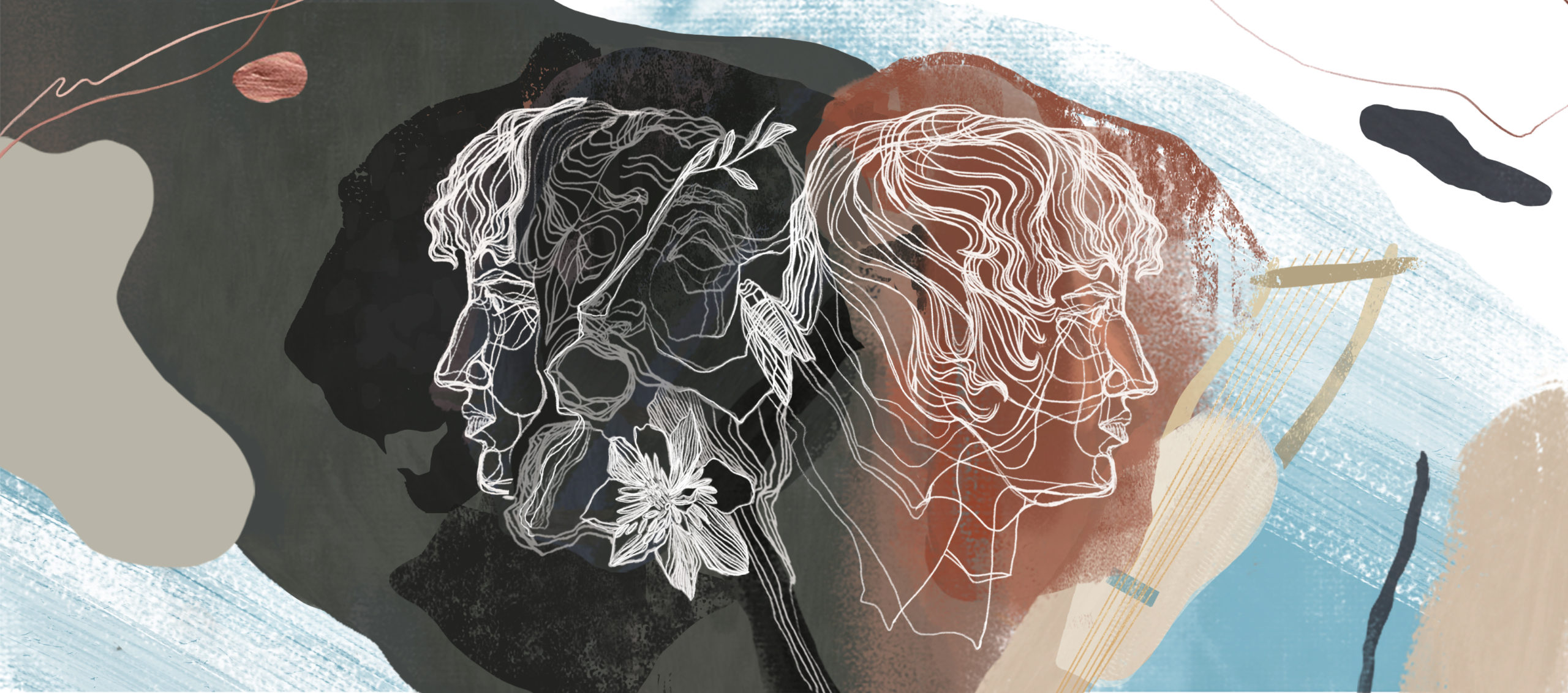
μάτρι ἀγάπατᾳ μοι In this concise two-part essay, I explore how specific prosodic qualities do not merely influence but fundamentally construct content in early (i.e., archaic or pre-classical) Greek thought – whether musical-poetic (Sappho) or aphoristic-philosophical (Heraclitus). In Sappho’s case, by prosodic qualities I mean, in particular, metric length and breathing, rhythmic phrasing and musical…
Category: Greece
Aphrodite’s Wounded Hand
Ancient Greek pair of eyes made of bronze, marble, frit, quartz, and obsidian. 5th century BCE or Later. Metropolitan Museum, New York. Object 1991.11.3a, b I A fresh look at Greek mythology requires perhaps that we view its gods (θεοί) both as those who offer us a deeper “insight” into things – for with just…
On Contingency & Worlding
Assuredly, reality’s laws, which Meillassoux interprets exclusively through physics’ lens (thereby bracketing biology) could be otherwise. But partly. Here, they are X; elsewhere, they are Y or Z or something else. Yet in their making many different factors, and types of causes, coalesce, some of them being contingent, others being necessary instead, and they do…
Four Notes on Plato… Upstream
Hypercomplex: there is probably no better adjective to describe Plato’s thought; and this explains, too, why it is so very easy to lose sight of what it invites us to reflect on and ponder, which is nothing different from thought’s endless beginning, meandering itineraries, and inner paradoxes. But then, how can one speak of essentialism…
Plato… minus Platonism (with a Note on Guattari and Deleuze)
It is with Heraclitus that the “thinkable” becomes the very object of thought – and I am tempted toassert that it is only then that philosophy properly begins. The apocryphal anecdote concerning the death of Homer contained in frag. DK B56 (to which I have already alluded here) hints at this in a lovely manner…
Political Geometries
At the diegetic beginning of the Theban cycle, excessive conjunctions and disjunctions (Ramnoux) between two different worlds, and within each of those worlds, take place (Zeus abducts Europa, Cadmos slays the dragon, the children of the dragon kill themselves, Cadmos has an incestuous relationship with Europa, etc.). The goal is then to find some rest…
AΓAΛMA
The Ancient-Greek word ἄγαλμα (agalma) did not merely designate a statue, which we wrongly take to be its most common meaning. In Homer, it is the precious object desired by everyone that embellishes, by making it shine, the harness of the horse of the best among the warriors – in short, it is the treasure…
“To Cast the Fish and Keep the Net” – Philosophy’s Uncanny Task
Merleau-Ponty’s later writings witness to a thematic shift from the study of perception to that of meaning as its supplement, in the Derridean sense of the term “supplement” – a shift that Merleau-Ponty himself describes in La Prose du monde with an eloquent metaphorical expression: “to cast the fish and keep the net” (jete[r] les…
Images of Thought
Interestingly, and as I have written elsewhere, this letter remains for us, Europeans, a typically Greek one (in German it is called ypsilon, which is its original Greek name; in French, i grec (“Greek i”); in Spanish, i griega). This very Greek “Y” symbolizes (or rather, pictures graphically; Pierce would have said that it is…
After Nietzsche
I Nietzsche claims that the way in which we picture the world affirms or denies what we are ready to put in it, in short, that our representations rely on a pre-representational basis, inasmuch as we see what we see depending on how we are inclined to value it. In other words, he underscores the…