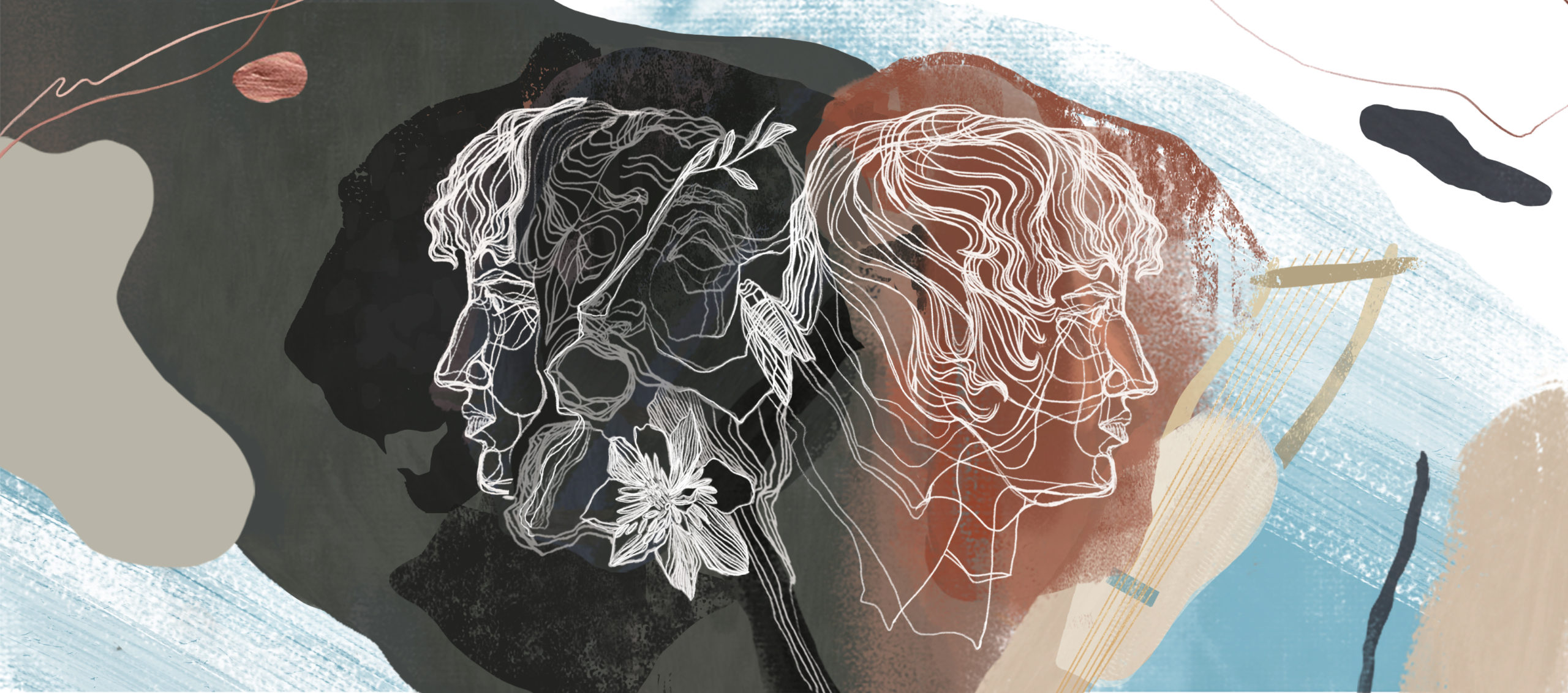
μάτρι ἀγάπατᾳ μοι In this concise two-part essay, I explore how specific prosodic qualities do not merely influence but fundamentally construct content in early (i.e., archaic or pre-classical) Greek thought – whether musical-poetic (Sappho) or aphoristic-philosophical (Heraclitus). In Sappho’s case, by prosodic qualities I mean, in particular, metric length and breathing, rhythmic phrasing and musical…
Category: Language
Four Notes on Plato… Upstream
Hypercomplex: there is probably no better adjective to describe Plato’s thought; and this explains, too, why it is so very easy to lose sight of what it invites us to reflect on and ponder, which is nothing different from thought’s endless beginning, meandering itineraries, and inner paradoxes. But then, how can one speak of essentialism…
AΓAΛMA
The Ancient-Greek word ἄγαλμα (agalma) did not merely designate a statue, which we wrongly take to be its most common meaning. In Homer, it is the precious object desired by everyone that embellishes, by making it shine, the harness of the horse of the best among the warriors – in short, it is the treasure…
Dreams as the Fugues of the Unconscious? On Musical Polyphony and Schizoanalytic Pragmatics
For Mahoro Murasawa and Kevin Swierkosz-Lenart I Like everything else, music is (to use a Guattarian concept) an “optional matter”; that is to say, there are many ways to organize any sound material. Take, for instance, the chromatic scale, which represents a way of classifying and gathering together a finite number of sounds, namely, twelve…
Seeds of Singing – or, What Else Can a Soul Be and Do
Pasolini’s Teorema (1968) ends with one of the characters, “Paolo,” a bourgeois middle-aged man, running naked through the wilderness out of shame, a profound anti-bourgeois shame. For, while Paolo is able to break off with the bourgeois order that he himself incarnates as both a bourgeois father and businessman, he proves incapable of replacing it…
The Eidos of a Mango Tree
I Unlike what Deleuze (1990, pp. 253-66) claims, it is not Plato but Aristotle (in An. Pr., I, 27) who reduces the individual to typological classification (this is an individual mango tree, mango trees belong in the mangifera genus, which are part of the anacardiaceæ family [fig. 1], etc.), which means that, from Aristotle’s standpoint,…
On Concepts
One of the many faces of contemporary philosophy expresses at least three interdependent emotional states which interchange depending on the occasion: a concern about how to relate to the Other, a repulsion against any kind of concepts, and a sincere fascination with the non-philosophical. It can all be said to begin with Levinas and Derrida,…
Metaphor and Meaning (I)
The Yanomami myth of the “falling sky” – which resembles that of the Celts reported by Ptolemy to Alexander during his campaign in Thrace against the Illyrians – offers a perfect site to briefly explore the relationship between metaphor and meaning. Davi Kopenawa narrates the myth thus: At the beginning, the sky was still new…
Words as Echoes
What would happen if propositions, which are the means we have to make sense of things (“this is this,” “that is that,” “this evening I will finish the paper,” “Liam loves me no more,” etc.), were not formed by words, but by images; or if the words themselves could be said to be images, not…
A Post-Anthropocentric Take on the Human Difference
C. Boesch writes that “wild chimpanzees seem to use drumming on buttressed trees to convey information and changes of travel direction.”(*) From this we may infer that at least some animals have symbolic language, i.e. an abstract and agreed-upon type of language. Conversely, iconicity (in terms of the mimicry of visual, sound, and olfactive forms,…