
μάτρι ἀγάπατᾳ μοι
In this concise two-part essay, I explore how specific prosodic qualities do not merely influence but fundamentally construct content in early (i.e., archaic or pre-classical) Greek thought – whether musical-poetic (Sappho) or aphoristic-philosophical (Heraclitus).
In Sappho’s case, by prosodic qualities I mean, in particular, metric length and breathing, rhythmic phrasing and musical rendition, paradigmatic and syntagmatic segmental distribution, syntactic structural antithesis, and semantic equivocation.
Let’s examine, specifically, the following three verses, which correspond (example A) to the first line of the first stanza of frag. 31, (example B) to frag. 151, and (example C) to the first line of the first stanza of frag. 1, as per Eva-Maria Voigt’s classification of the extant material.<1>
A.
The first line of the first stanza of frag. 31 reads thus:
Φαίνεταί μοι κῆνος ἴσος θέοισιν
Phainetai moi kēnos isos theoisin
Literally, word by word and considering that (i) in Ancient Greek personal endings follow the verb instead of preceding them as personal pronouns (appears~he instead of he appears), and that (ii) what we would call case-governing prepositions follow the pronoun or noun as declension- or case-endings instead of preceding them as proper prepositions and that the determinate article can be omitted (me~to instead of to me; similar the~gods~to instead of similar to the gods):
{appears~he • me~to • that-one • similar • [the~]gods~to}
i.e., (he appears) • (to me) • that-one • similar • (to the gods)
Or in my translation, which I shall later try to justify, and which includes a caesura or pause (–):
Appears! He does to me – similar to the gods
For Sappho composes in Aeolic meter; hence, she plays – variously, i.e., freely – with the following metrical pattern, or choriamb foot:
– u u –
which in this case gives:
– u – x | – u u u – u –
Φαί-νε-ταί μοι | κῆ-νος ἴ-σος θέ-οι-σιν
where, (a) in terms of metric length, “ – ” stands for a long syllable, “ u ” stands for a short one, and “ x ” stands for either a long or a short syllable, while “ | ” marks – from the standpoint of (b) the verse’s rhythmic phrasing and musical rendition – a caesura between its two segments (or colons) of unequal metric length – corresponding to two full breaths alsoof unequal length.
Now, what distinguishes those two segments – in addition to their different metrics, that is? A difference in terms of (c) organizational composition, according to which the first segment (S1):
Φαίνεταί μοι
Phainetai moi
{appears~he • me~to}
Appears! He does to me
is iconic or paradigmatic, for it expresses a (more-or-less sudden) vision (x appears!) perceived by someone(me = x appears to me) rather than a merely subjective impression (x seems to me). Conversely, the second segment (S2):
κῆνος ἴσος θέοισιν
kēnos isos theoisin
{that-one • similar • [the~]gods~to}
similar to the gods
is narrative or syntagmatic, as it describes the object of the vision in question (he/that one), who is thereby qualified in a certain way (namely, as being similar to the gods).
As we shall see, this segmental distribution (vision + description) is recurring in Sappho and extraordinarily effective: it separates an event (S1) from a thought (S2), a perceived event from an elaborated thought – both being the two senses of the noun νοῦς (nous): “vision\thought,” and of the verb νοεῖν (noein): “to see\think.”
Consequently, when Anne Carson renders:
Φαίνεταί μοι κῆνος ἴσος θέοισιν
as
“He seems to me equal to the gods that man”<2>
several things are – I fear – lost sight of, whereas others are – I fear too – either overstressed or confused, to wit: (1) the opening apparition\vision is transformed into a purely subjective seeming;<3> (2) its advent is therefore erased; (3) it all comes then to gravitate around the personal nature of the object of the vision who, by being introduced twice, at the outset and in fine of the verse, is given prominence above anything else, including the opening event and his likeness to the gods themselves; and lastly (4), the beautiful (d) syntactic structural antithesis displayed by the two datives (“Appears! — he does to me; similar to the gods”), which can be diagrammed thus:
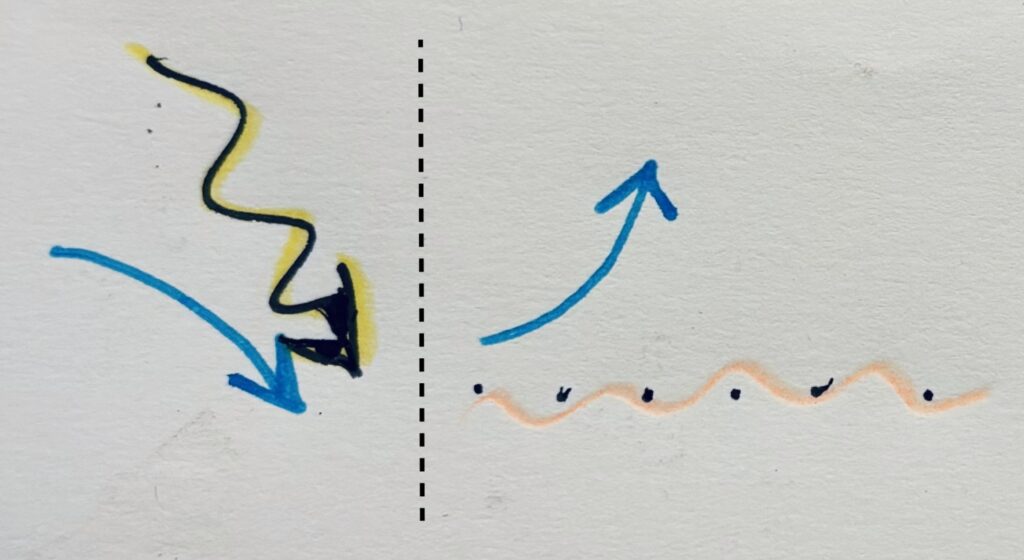
(where the black vertical discontinuous line stands for the caesura separating S1 and S2; the yellow-and-black arrow stands for opening event in S1; the black dots and the ondulatory line stand for the thought elaborated in S2; and the two blue arrows stand for the datives found in each segment, one moving downwards: to me, and the other one moving upwards: to the gods) is entirely obliterated.
As for Yves Battistini’s French translation of S1: “il m’éblouit” (he dazzles me),<4> it captures finely, I think, the enchantment provoked by the divine resemblance at stake, but it somehow sacrifices the opening apparition to the vision that witnesses and hence sustains it.
B.
Bearing all this in mind, let us now turn to frag. 151, which reads:
ὀφθάλμοις δὲ μέλαις νύκτος ἄωρος
ophthalmos de melais nyktos aōros
{the~eyes~over/in • now/then/ah! • [the~]blacknessess~into • [the~]night~of • premature}
i.e., over the eyes • ah! • (the darkness) • (of the night) • (prematurely)
Over the eyes, ah! – night’s darkness prematurely
u – u u | – – – – – – u
Here, once again, a caesura divides the verse into two halves
ὀ-φθάλ-μοις δὲ | μέ-λαις νύκ-τος ἄωρος
though the division is effected this time by the action of a small yet versatile particle – δὲ – which can function alternately as an adversative or coordinating conjunction (“but,” “and”), as an adverb (“now,” “then”), or even as an interjection (“ay!,” “ah!”). Carson notices it this time and renders the verse thus:
“and on the eyes | black sleep of night”<5>
Yet, she ignores the prematureness of such event by interpreting ἄωρος as “sleep” rather than as an adjective (which is possible but, it seems to me, less effective), and by aligning ἄωρος with μέλαις despite μέλαις being feminine and ἄωρος masculine – as is ὀφθάλμοις, with which ἄωρος aligns in a breathtaking loop.<6>
Besides, μέλαις matches ὀφθάλμοις in case and number (though not in gender), so another possible translation would be:
The eyes, ah! – darkened by the night, prematurely
C.
Let’s finally look into the first line of the first stanza of frag. 1, which admits two different readings depending on whether the eighth letter of the first word in taken to be a θ (th) or a φ (ph):
Variant 1:
Ποικίλοθρον ἀθανάτ᾽᾽Αφρόδιτα,
Poikilothron athanat’ Aphrodita
{Spangled~throne • immortal • you Aphrodita}
Spangled-throne! – O immortal Aphrodite
Variant 2:
Ποικίλοφρον ἀθανάτ᾽᾽Αφρόδιτα,
Poikilophron athanat’ Aphrodita
{Spangled~mind • immortal • you Aphrodita}
Spangled-mind! – O immortal Aphrodite
Here, as in example A above, the caesura occurs after the first word – ποικίλοθρον/ποικίλοφρον in this case, i.e., an adjectival compound resulting from the admixture of the adjective ποικίλος (“many-coloured” cum “scintillating”) and the noun(s) θρόνος (“throne”)/φρήν(“mind,” “heart”):
– u u – | u u – u – u u
Ποι-κί-λο-θρον | ἀ-θα-νάτ᾽Α-φρό-δι-τα
Carson opts for ποικίλοφρον… ᾽Αφρόδιτα (“spangled-mind… Aphrodite”),<7> which in her view suits best – she writes – the goodess’s “agile” presentation throughout the rest of the poem.<8> But why would this imply ruling out the goddess’s magnificent, initial apparition on her bejewelled throne?
Besides, ἀθάνατον (“immortal,” of which ἀθανάτ᾽ is a contraction) concords with ποικίλοθρον/ποικίλοφρον (they are both in the accusative), which suggests that they could be brought together and the caesura be thus semantically displaced right before Αφρόδιτα (which is in the vocative instead), thereby giving two further variants:
Variant 3:
(You) (of) spangled-, immortal-throne – O Aphrodite!
Variant 4:
(You) (of) spangled-, immortal-mind – O Aphrodite!
in a mesmerizing figure-ground reversal.
In Sappho, then, verses are often double-tailed, articulating either a single motif sounding at two different harmonic registers, or two complementary melodic figures, analogous to the paired themes of a micro-sonata.
Notes
<1> Sappho et Alcaeus. Fragmenta, ed. Eva-Maria Voigt. Amsterdam: Athenaeum, 1971.
<2> If Not, Winter: Fragments of Sappho, trans. Anne Carson (bilingual ed.; New York: Vintage Books, 2003), p. 63.
<3> As is in Diane Rayor and André Lardinois’s translation: “To me it seems that man has the fortune / of gods” (Sappho. A New Translation of the Complete Works, trans. Diane J Rayor and André Lardinois [Cambridge & New York: Cambridge University Press, 2014], p. 44); and in Jim Powell’s: “In my eyes he matches the gods, that man” (The Poetry of Sappho, trans. Jim Powell [Oxford & New York: Oxford University Press, 2007], p. 11).
<4> Sapphô. Odes et fragments, trad. Yves Battistini (bilingual ed.; Paris: Gallimard, 2005), p. 39. Cf. David Campbell’s: “He seems as fortunate as the gods to me” (Greek Lyric, I: Sappho and Alcaeus, trans. David A. Campbell [Cambridge, MA & London: Harvard University Press, 1982] p. 79).
<5> More precisely: with a line break between both segments, plus making S2 starts there were S1 ends (op. cit. [supra n.2], p. 305) – which seems to me to be a better translation than the somewhat disjointed version by Rayor and Lardinois: “while eyes, the black sleep of night” (op. cit. [supra n.3], p. 81).
<6> I find Campbell’s and Powell’s versions far more appealing: “and night’s black sleep (closes … ) eyes” (Campbell, op. cit. [supra n.4], p. 163); “over the eyes night’s black slumber” (Powell, op. cit. [supra n.3], p. 37).
<7> Ibid., p. 3.
<8> Ibid., p. 357 n.1.1. Rayor and Lardinois translate instead: “On the throne of many hues, Immortal Aphrodite,” thereby dissolving the immediacy of vision of the goddess(‘s throne, see below) into a prepositional phrase of place of descriptive nature (op. cit. [supra n.3], p. 25). Once again, Powell’s translation strikes me as more convincing: “Artfully adorned Aphrodite, deathless” (op. cit. [supra n.3], p. 3). Cf. Campbell’s: “Ornate-throned immortal Aphrodite” (op. cit. [supra n.4], p. 53)