Hypercomplex: there is probably no better adjective to describe Plato’s thought; and this explains, too, why it is so very easy to lose sight of what it invites us to reflect on and ponder, which is nothing different from thought’s endless beginning, meandering itineraries, and inner paradoxes. But then, how can one speak of essentialism in Plato? There is none. There never was. Plato – his thought as much as his textuality – can be rightly compared to a fathomless detour. The critical nature of the later dialogues reflects that of the early dialogues, and the middle ones are no exception to this. Borrowing from Derrida – or should one look at it the other way round? – Plato’s noetics, ontology, and psychology can be said to outline a radical philosophy of difference whose sole purpose is to facilitate an approximate focusing of what remain always out of focus, by inquiring into what can be provisionally focused on each time. On a close reading that cannot but disprove the pretensions of Platonism as well as Aristotle’s misleading assumptions on Plato’s alleged essentialism, Plato’s genuine thought-image (to put it in Guattarian terms) emerges afresh through numberless ellipses, out-of-fields and other dramatic strategies, through mythical narratives that highlight, if anything, philosophy’s inherent fragility, and through uncanny questions that fractalize themselves relentlessly and challenge thought’s limits from within – Plato’s thought-image surfaces, thereby, as a kaleidoscope or a prism about which nothing should be taken for granted save, perhaps, the way in which the light is diffracted on its many faces: obliquely. Briefly: ideas are at once situated and abstract, thought oscillates permanently between two iridescent poles, the soul dissolves while it attempts to take shape, being proves to be pure interference, and if there is something secure behind all this it is merely, on the one hand, a disposition towards the thinkable that may be qualified as erotic and, on the other hand, thought’s own unrepresentable and thus paradoxical space.
BEFORE SPECULATIVE REALISM (a note on Plato’s Cratylus)
After describing them elsewhere as a reasonable hypothesis (whose difficulties he himself never overlook), in Crat. 439c Plato describes the εἴδη (the “ideas”) as the object of a certain “dreaming” (ὀνειρῶξαι): one that, one may infer, aims at nuancing to the extent in which it might be deemed possible, from within language itself and therefore in a limited way, the ambiguities inherent in language, and thus in reasoning; but without pretending (cf. ibid., 432b) that reality itself fits into the mould of what can be uttered! Hence, my listlessness before a good many of the texts that dress up speculative realism’s windowless room, where thought is, as it were, asked to play the part of Lady Alroy in Wilde’s tale, “The Sphinx Without a Secret.”
ON NECESSITY & VISION (a note on Plato’s Timaeus)
Plato’s key distinction between ἀνάγκε and νοῦς, necessity and thought in Tim. 48a, could perhaps be paraphrased thus: There is, on the one hand, the domain of ἀνάγκε (“force,” “necessity”), of the blind forces that act upon everything and compel it, and there is that of the vision (νοῦς, “insight”) that steps aside and cuts their flow thereby opening up a space for the otherwise where, in contrast to the domain of ἀνάγκε where everything just follows, questions can be formulated, decisions be pondered, and actions be undertaken beyond the limits imposed by randomness and contiguity. If this proposed rewording makes sense, however, would such distinction not amount to a modal distinction: between the closed and the open, the given and the possible? And could one then, on this very premise, reimagine too Plato’s well-known distinction between ψυχή (“soul,” which is made of the same non-matter as the νοῦς) and σῶμα (“body”)? – a distinction that, as Clémence Ramnoux observed long ago, was first made by Democritus; that, in Plato, could then be simply taken to mirror the modal distinction between the given and the possible; but that at the same time remains, undeniably, somewhat excessive, as originally ψυχή and σῶμα were only attributed qua separate things to the dead (as a dead person’s shadowy image and corpse, respectively). What about the “eternity” of the intelligible (48e) and of the soul in Plato? I know, we have to cope with that! But then again, what precludes us from viewing the alleged eternity of the thinkable (that is, the alleged eternity of the ideas) as its (their) ever-thinkable nature; the alleged eternity of the soul, for its part, as our ever-recurring chances to think –which is, it seems to me, how Monique Dixsaut interprets Plato’s ἀνάμνησις in the Meno; and the co-incidence of both eternities (the unfolding of one onto the other, that is), as thought’s eternal recurrence?
ON BEING AS INTERFERENCE (a note on Plato’s Sophist)
As I have written in a previous entry, In Plato’s Sophist (254d–264b) “being” proves to be a dimension crossed by four other dimensions, to wit, sameness, otherness, stillness, and becoming; plus, in contrast to Parmenides, it is not completely alien to non-being (which can be read as a fractalized version of the previous statement, and vice versa). This turns “being” into an interfered and interfering dimension, among others. Thus, I am tempted to superimpose Plato’s five μέγιστα γένη or “great genres” (again: being, sameness, otherness, stillness, and becoming) and Guattari’s fourfold as follows:
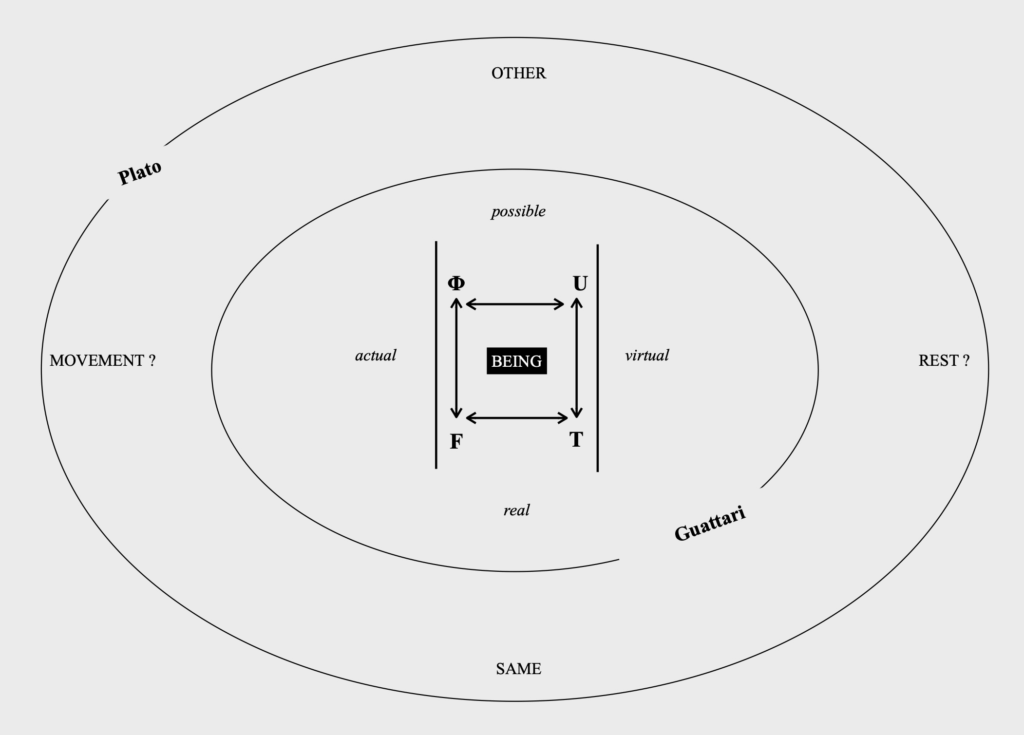
(Source: Carlos A. Segovia, Guattari Beyond Deleuze: Ontology and Modal Philosophy in Guattari’s Major Writings [London & New York: Palgrave Macmillan, 2024], p. 99.)
ON SITUATEDNESS & ABSTRACTION (a note on Plato’s Phaedo)
Plato, Phaedo, 100e–102e: “Tall” can be said of X and “taller” of X in comparison to Y; both terms denote X’s being. But x becomes “short” in comparison to Z, if Z, in turn, happens to be taller than X. Concepts are here nothing more, then, than situated predicates. What, though, makes of x someone tall? The length of X’s body? The size of X’s head? No, because all that makes X taller than Y but shorter than Z. What makes of x someone tall (or someone short, depending on the circumstances) is the very idea of “tallness” (or “shortness”), which cannot, and do not, transform into each other. Therefore, concepts become at this other level, as I have also stressed elsewhere, purely abstract ideas. Now, by saying: the difference between a greater and a longer tallness is a difference in terms of degree, rather than a difference in terms of nature, we happen to add yet another layer to the domain of pure abstraction. Accordingly, depreciating abstraction on behalf of situatedness proves as sterile as depreciating situatedness on behalf of abstraction.