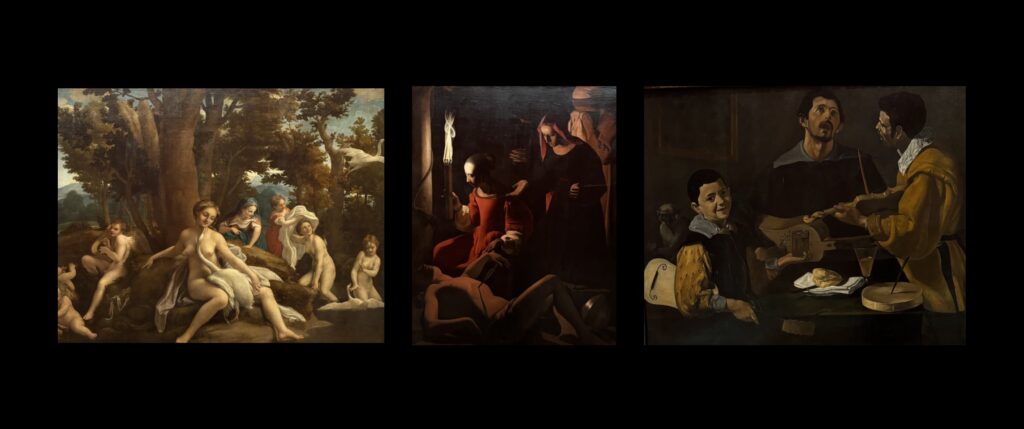
Three images stand in Berlin’s Gemäldegalerie in a kind of silent disproportion to one another, as though the museum had accidentally opened a breach and allowed three distinct ontological climates to coexist without mediation. One gets immediately caught in their differing ways of breathing—one swollen with movement, one suspended in inward gravity, one abruptly turned outwards.
Correggio’s Leda and the Swan (1532) does not so much depict an event as release a continuous curvature into visibility. The swan’s (i.e., Zeus’s) neck, Leda’s torso, the slender arboreal axis at the centre—none of these figures holds its place; each is a momentary knot in a broader undulation whose rhythm configures the scene itself. It is as though Correggio had discovered—long before Murnau: did Rohmer know?—that form does not precede movement but is secreted by it, condensed like foam upon a single, uninterrupted current.
Thus in Correggio movement is not represented: it is the condition of apparition itself. What we call “Leda,” “swan,” “tree,” are merely local contractions of an ontological tide that has not yet learned to differentiate between subject and environment. Likewise, the myth is no longer narrated but held in a single, elastic present, as though duration had forgotten how to unfold and instead turned upon itself in luminous suspension.
Conversely, La Tour’s Saint Sebastian’s Body Discovered by Saint Irene (1649), moves inward until it all becomes almost imperceptible and yet thereby, paradoxically, all the more intense. The world is no longer in motion: it becomes silence and attentiveness. For here gestures do not unfold in space but in interior cadence. The diagonal sequence formed by the arpeggiated distribution of the hands of the different characters depicted next to St Sebastian’s lying body—hands gathered around the face, then joined together in a kind of prayer, then open in a welcoming gesture, and finally delicately touching and holding—does not describe an action but composes a slow metaphysical descent from visibility into care. Each figure receives only a fragment of a gesture that no single body can complete. The movement is distributed in style brisé (or style luté), each note withheld from full resonance, yet insisting on belonging to a unity that never appears as such.
In La Tour, therefore, movement no longer traverses the visible; it sinks beneath it. One might say that being ceases to circulate and begins to gravitate, slowly, towards the possibility of contact. The image no longer opens onto the world; it gathers the world towards an almost unsayable point of tenderness, where seeing is no longer sufficient and must yield to a quieter mode of presence.
And then—Velázquez. The Three Musicians (c. 1616) does not envelop the viewer; it interrupts him. Something in the composition refuses closure. The density of the ordinary—bread, glass, rough fabric, instruments held without ceremony—neither elevates itself into symbolism nor does it merely dissolve into atmosphere. If those things are precisely there, it is with an almost obstinate factuality, or even stubbornness.
Yet Velázquez’s fidelity to the given—which somehow epithomizes the naturalism often attribute to the Spanish Baroque painters—is strangely shaken by a rather bold event. One of the figures looks outward. But this gesture is not simply directed at us; it displaces the ontology of the image itself: the scene ceases to be self-enclosed and develops an aperture that cannot be localised within its internal geometry, because it coincides with the very act of being seen. In short, the painting does not precede the gaze; it requires it, for it is relational from the outset, as though its substance were made not of represented things but of addressedness.
In this sense, Velázquez displaces the ontological regime of depiction itself. The image becomes an event that cannot close upon itself, because its very coherence depends upon an outside that itprovonkingly integrates—the same, of course, stands for Las Meninas. And, somehow, modernity begins there—not as a stylistic threshold, but as the discovery that visibility is never self-sufficient, that it always implies a field of exchange in which the beholder is already implicated before recognition.
Modernity begins at a price, though, that the comparison of these three paintings makes patent: in de la Tour and Correggio, the world is more than the given; in Velázquez, however, it fully coincides with it—even if the given does not stand before us, even if we, too, are part of it.
Thus the three paintings do not form a progression so much as a fracture in three directions. Correggio disperses being into movement. La Tour withdraws it into inward gravity. Velázquez negotiates it in the space between gaze and image.