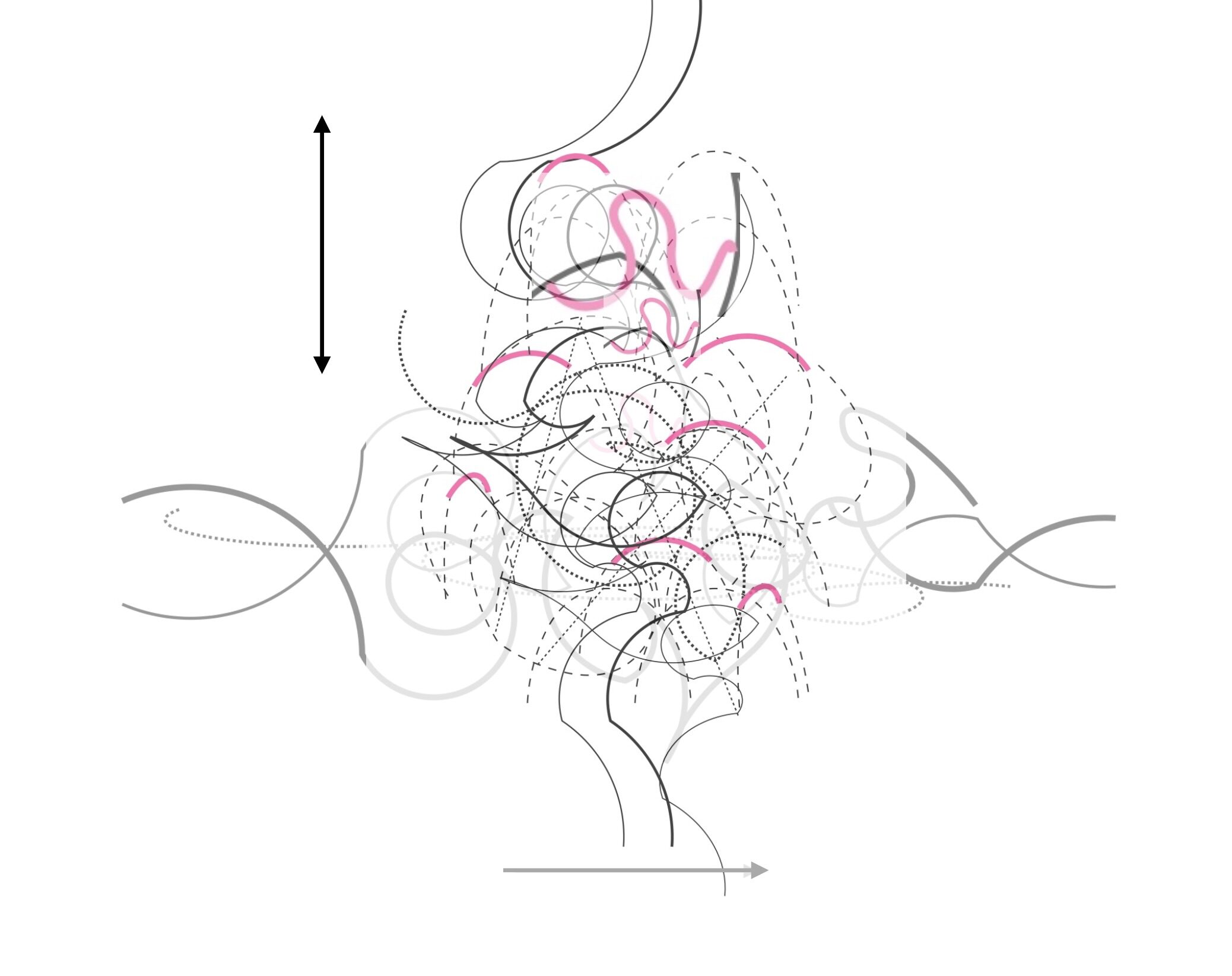
The tuning of the Baroque or—at least until Weiss—French lute does not merely cipher its technical disposition to produce music in a certain way, but sets forth a peculiar ontology of music itself—one that slips away from the familiar grammars of linear melody and architectural harmony, opening instead onto a more unstable field where sound thinks itself as delay, mirror, evanescence, and fragmentation, and deferred coherence, where what is heard arrives already fractured, as though music were never fully present to itself.(*)
If one listens to the violin or the cello, tuned in fifths, one hears immediately a kind of laddering of time that transforms music into a narrative event. Music climbs or descends, step by step, as though each string were a rung upon which the ear must place itself in succession. Fifths, with their structural authority within tonal space, consolidate this impression: from tonic to dominant, from repose to tension, from tension to a return that is less closure than renewed departure. And even when polyphony thickens or chords briefly suspend the line, the underlying imagination remains stubbornly sequential. In short, time is here a disciplined corridor of progression—while sound becomes narrative without remainder.
The piano, for all its astonishing capacity to render simultaneity, does not entirely abandon this logic. Its keyboard is still a visible topology of ascent and descent, a surface upon which pitch is spatially diagrammed. What changes is not so much the linearity of musical thought as the possibility of vertical saturation: multiple tones striking at once, producing an architecture of resonance. Yet even this architecture remains bound to a grid, a stable geometry in which harmony becomes spatial volume. One might say that the piano introduces depth into musical space, but it does not yet undo the assumption that music is, in essence, a structured extension.
A first displacement appears in earlier systems such as the viola da gamba and the early lute traditions tuned in fourths with a central third. Here, the ladder collapses on behalf of an axial logic: the third becomes a centre of gravity around which fourths unfold in mirrored equilibrium. Music no longer advances; it balances. The ear is no longer carried forward but held in a field of reflection, where symmetry replaces succession and contemplation replaces trajectory. Sound is no longer a path but a distribution of forces around an invisible pivot.
Yet it is the French lute that brings this transformation to a point of extraordinary subtlety and conceptual density. Its tuning, articulated around two chords of D minor (A–D–F, A’–D’–F’), appears to establish a centre, but it actually duplicates it, thus placing resonance as its secret core. What thus emerger is not an axis but a double gravitation, a pair of resonant nuclei—like twin stars—whose mutual attraction organizes the entire sonic field. Centrality ceases to be a point and becomes a relation; it ceases to be geometry and becomes dynamics.
This duplication of D minor introduces, moreover, a curious inward turn. For D minor, with its minor third, already carries a tonal inclination towards interiority—towards a kind of contemplative withdrawal from exterior brightness. But in the lute, this inwardness is doubled, mirrored, and thereby deepened. The instrument does not project affect outward; it folds it inward, producing a sonic space that seems less like an expanse than like a slow contraction around its own centre(s) of gravity. Music becomes less utterance than absorption.
From this dual nucleus, the remaining courses of strings do not merely organize themselves as a scale to be traversed or a structure to be surveyed. They behave instead like a field of resonances, each pair of strings generating micro-events of vibration that cannot be reduced to linear order. What one calls melody persists, but only as a surface effect of deeper harmonic pressures. Succession is no longer foundational; it becomes the perceptible trace of gravitational movements.
The term “trace” is indeed crucial here. For in the style luthé the distinction between presence and absence ceases to function as a simple opposition.(*) Every note is narrowed by what resonates with it while being simultaneously thickened by what does not. Every resonance, that is, carries its own shadow-field, its halo of unrealized vibration. What is heard is inseparable from what is structurally withheld. Music, in this sense, is no longer the presence of sound but the modulation of an active absence—an exquisite heap of ashes:
[L]a cendre n’est pas, elle n’est pas ce qui est. Elle reste de ce qui n’est pas, pour ne rappeler au fond friable d’elle que non-être ou imprésence. […] [L]a cendre […] ce que reste sans rester […].(**)
“Cinders are not—they are not what is,” since they are mere traces of what once was. Yet, at the same time, “they remain from what is not,” i.e., from what is no longer, and “thus recall [twice] at their delicate, frail core, non-being—non-presence.” Hence “cinders” are—however being only improperly, for they are not—“what remains without remaining.” (My translation.)
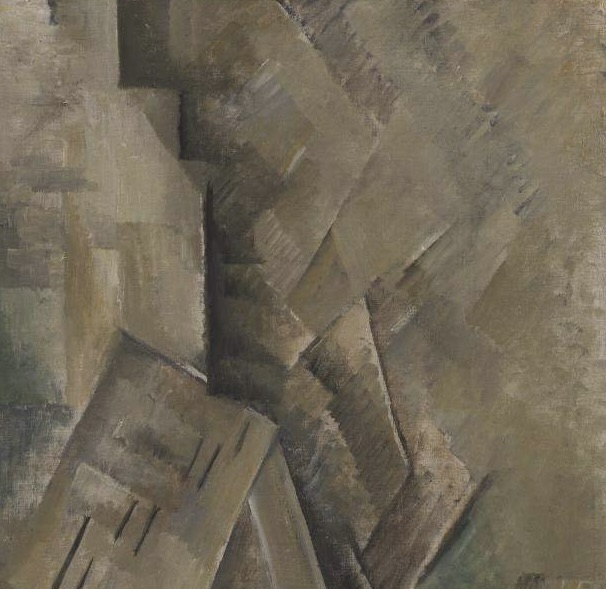
Georges Braque, Mandora (1909–1910), detail. Tatę Gallery, London
(*) Style brisé is a modern term; style luté (sic; i.e., style luthé), François Couperin’s expression in L’Art de toucher le clavecin (Paris: Chés l’Auteur, le Sieur Foucaut, 1716), p. 61.
(**) Jacques Derrida, Feu la cendre (Paris: Éditions des Femmes, 1987) pp. 23, 27.