It is incredible that, after about 700 years of discussing on art’s essence and pushing its boundaries further and further – sometimes in extremely interesting ways, other times in less compelling fashion – we have ended up in turning art into either allegory or imitation.(*) For both are merely forms of re-presentation, and re-presentation has often been considered, and with good reasons, art’s poorest form.
Allegory and imitation, then. And both put to the service of art understood as a means of self-expression; or, in rigour, reduced to being only that – which is an additional mistake, regardless of the important part that self-expression plays in any artistic manifestation. Self-expression, therefore, as the (basic) theory of today’s miserable art; imitation and allegory as the method.
Yet there is no method without style, and the possibilities prove here endless: creepy art, stand-show, committed art, etc. After all, the logic of an unrestricted circulation and conversion of commodities rules over our world. This, and the compulsive need to tell one’s story. For a world of commodities is a world of self-centred consumers, whose personal concerns and tastes are prioritized above all else.
In so deplorable a context, what then can be art’s role if art is to be reborn from its ashes – after having been sacrificed, like everything else, in the altar of an indifference that turns it unthinkable? Probably the very same role that art has always, if in various ways, undertaken. Blanchot hints at it when he suggests that through poetry we are oriented towards a relationship with the unknown – that is to say, with what exceeds the world as we know it and defies our imagination, at once sensible and conceptual, to picture it otherwise, daringly but timidly.
Among the performative arts, butō may be viewed, I think, as an unparalleled site for this, given its distinctive relationship to the unknown. And perhaps there is no exaggeration in affirming that it is called upon today, then, not only to be reborn from its own capture within the ideology of defiguration (wherein self-centredness is just reversed) but also to renew – and thereby restore – art’s being.
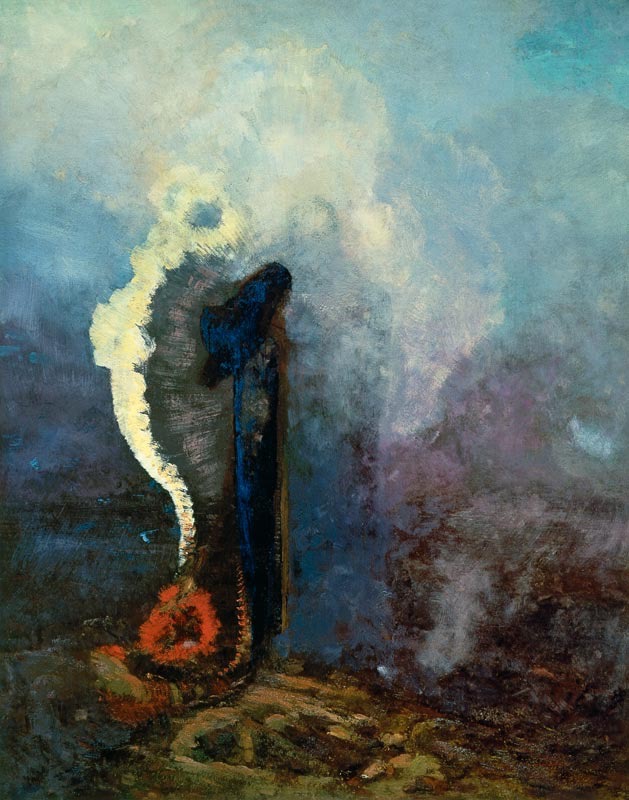
Odilon Redon, Le rêve (1904)
(*) I am primarily referring here to the performative arts, which otherwise are often dominated by a neo-Dada sensibility that simply offers another – more random – vehicle for what I describe below as self-expression.