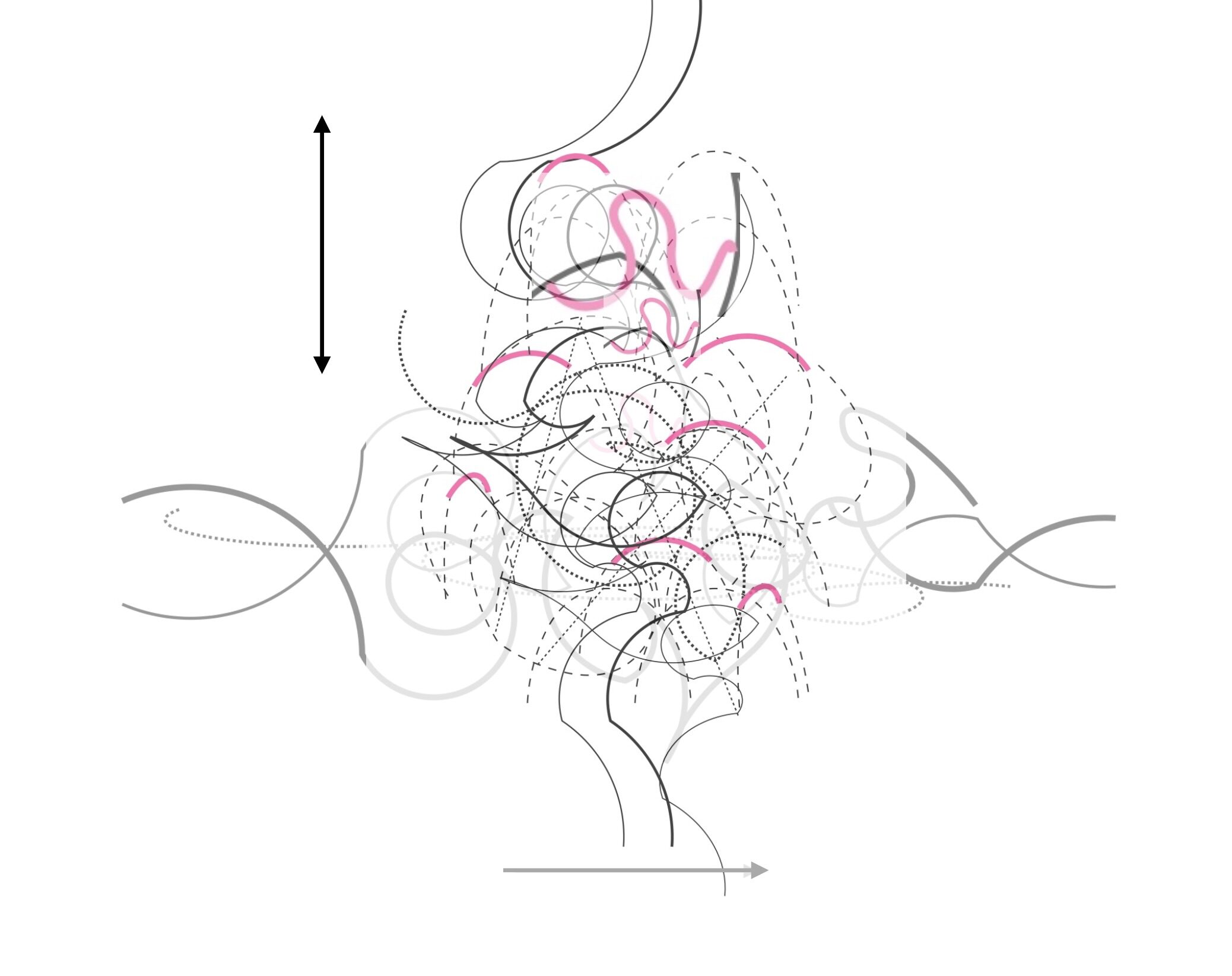
What does it mean to say that we are at once auto- and allo-poietic, endo- and exo-consistent, different and non-different from what is in one sense, but in another sense no longer remains, external to us? And, even more importantly perhaps, what does it mean to realize that we are unceasingly sliced and spliced between…
Category: Otherness
“To Cast the Fish and Keep the Net” – Philosophy’s Uncanny Task
Merleau-Ponty’s later writings witness to a thematic shift from the study of perception to that of meaning as its supplement, in the Derridean sense of the term “supplement” – a shift that Merleau-Ponty himself describes in La Prose du monde with an eloquent metaphorical expression: “to cast the fish and keep the net” (jete[r] les…
Images of Thought
Interestingly, and as I have written elsewhere, this letter remains for us, Europeans, a typically Greek one (in German it is called ypsilon, which is its original Greek name; in French, i grec (“Greek i”); in Spanish, i griega). This very Greek “Y” symbolizes (or rather, pictures graphically; Pierce would have said that it is…
After Nietzsche
I Nietzsche claims that the way in which we picture the world affirms or denies what we are ready to put in it, in short, that our representations rely on a pre-representational basis, inasmuch as we see what we see depending on how we are inclined to value it. In other words, he underscores the…
Butō & Philosophy
To “represent” (vorstellen) something and to “position” (stellen) it in its “place” (Stelle) is said in German after the same verbal root, which is also inherent in the word Gestell: “positioning,” “enframing.” With the latter term, Heidegger points at the generalized availability in which things stand before us – a trait which is peculiar to…
Dreams as the Fugues of the Unconscious? On Musical Polyphony and Schizoanalytic Pragmatics
For Mahoro Murasawa and Kevin Swierkosz-Lenart I Like everything else, music is (to use a Guattarian concept) an “optional matter”; that is to say, there are many ways to organize any sound material. Take, for instance, the chromatic scale, which represents a way of classifying and gathering together a finite number of sounds, namely, twelve…
Athena’s Shield
Detail of a 1st-century Roman copy of one of the statues of Athena sculpted by Myron and housed in the Parthenon. Madrid, Prado Museum. Photograph taken by the author I “I will not turn you into stones with snake-haired terror (schlangenhaarigem Schrecken): with my shield of beauty (Schild ,Schönheit‘) I protect myself.” Thus reads one…
“We Fight Because We Die” (III): Extra-Modern War and Its Moral Supplement
(N.B. This entry follows from the previous one, titled: “An Existentialist Approach to Extra-Modern War”) Pierre Clastres states that “primitive societies […] invest themselves totally in their religious and ritual life, which unfolds as a continuously repeated affirmation of the communal Self,” and hence that “[e]ach ceremony is a new opportunity to remember that if…
“We Fight Because We Die” (II): An Existentialist Approach to Extra-Modern War
(N.B. This entry complements the previous one, titled “We Fight Because We Die” (I): On Extra-Modern War as a Question of Social Logic.”) We die. It can hardly be minimised. Thus the common ancient-Greek terms for men: θνητοί, “mortals.” During the opening seconds of Robert Gardner’s beautiful ethnographic film, Dead Birds (1964), the camera follows…
“We Fight Because We Die” (I): On Extra-Modern War as a Question of Social Logic
In Chapter 11 of Archeology of Violence, subtitled “War in Primitive Societies” – the term “primitive” has different connotations in French than it has in English: it means something like “original” or “primordial” in the Rousseauian sense, which is overtly non-evolutionist – Pierre Clastres begins by tracing a sharp contrast between two phenomena, namely, the…