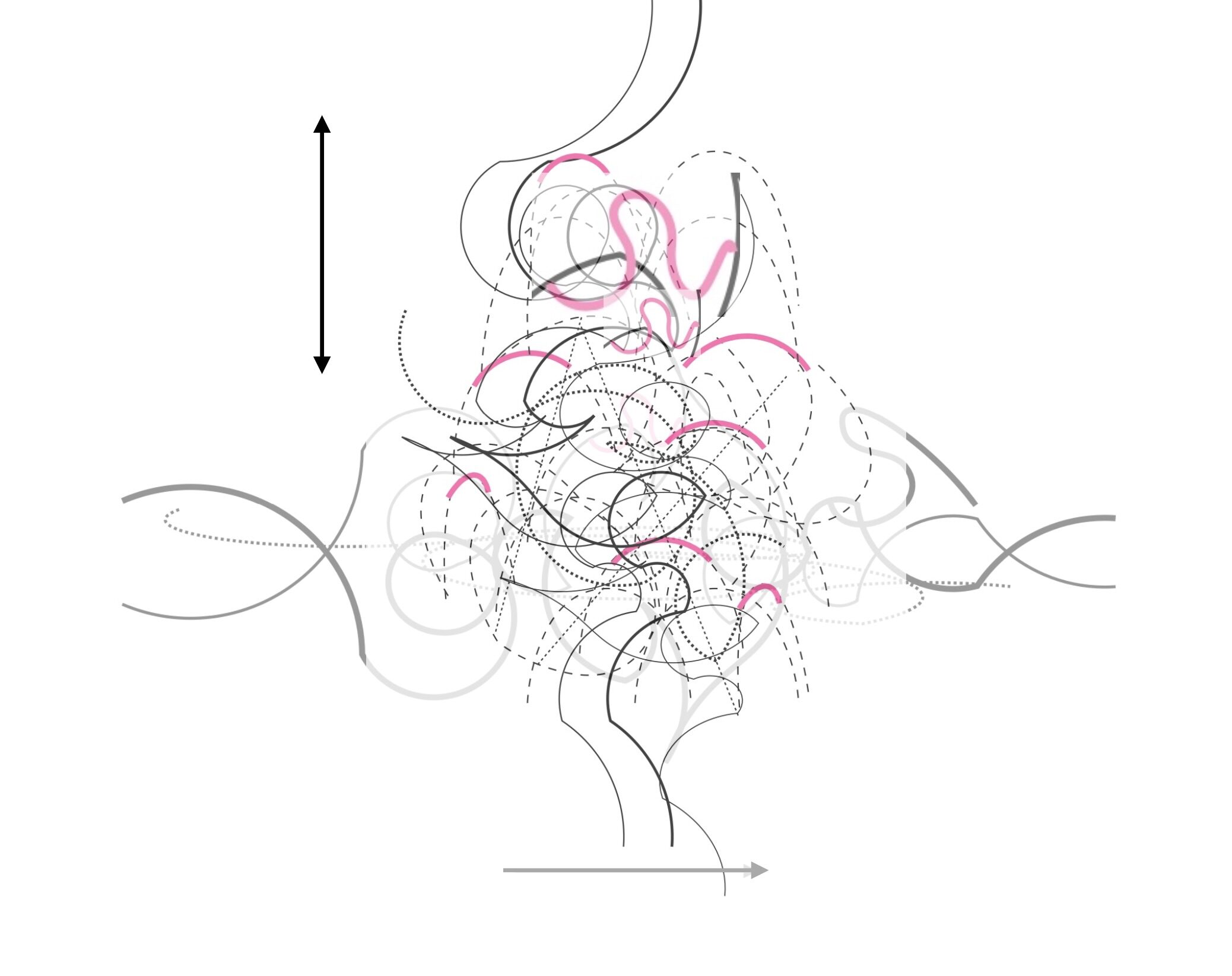
1 “The power to change form – power over the image – can be seen as the ultimate realisable power in a society dominated by consensual (visual) image,” writes Roy Wagner.(⊛) By “consensual (visual) image” Wagner means what is commonly (and poorly) known as “tradition.” Take, for example, any extra-modern ritual: on the day in…
Category: Otherness
An Eternally-Recurrent Déjà-Vu (travelling to St. Petersburg)
In The Aleph Borges distinguishes two types of labyrinth: (1) the palace with its madly intertwining corridors and (2) the desert with its not-less disquieting, confusing boundless-ness. But he makes such distinction only to add a third and even-more-perplexing type: (3) the endless book whose first page is mysteriously renewed each time the book itself…
Meaning: From Plato to Kant, Merleau-Ponty, and Wittgenstein
Consider the following image: The figures in it represent what language says, i.e. such or such words (“bird,” “snowflake,” “tree,” “mountain”),(⊗) whereas the ground (the white space inside the square) stands for the dimension that makes meaningful what language says. By the “dimension that makes meaningful what language says” we do not mean a word’s…
Anthropology as Heterology
It was Herder (1744–1803) who coined the term Volkskunde (pl. Völkerskunde), which may be translated as the “knowledge” of the “popular traditions” and “cultural practices” of a given “nation” or “people.” But it was not until 1839 and 1843 that the first learned ethnological societies were established in Paris and London, respectively. The Ethnological Society…
The Other(s) – In Homage to Borges
I saw all the mirrors on earth and none of them reflected me… – Borges We have already mentioned in a different context a passage in Jean Oury’s Création et schizophrénie in which, inquired by the therapist, a schizophrenic patient evinces her lack of self-recognition: upon looking at herself on a mirror, she sees no…
Turning Physics into Semantics: On Extra-Modern Magic
The real question is not whether the touch of a woodpecker’s beak does in fact cure toothache. It is rather whether there is a point of view from which a woodpecker’s beak and a man’s tooth can be seen as “going together” (the use of this congruity for therapeutic purposes being only one of its…
Metaphor and Meaning (II)
PREVIOUS PART HERE In Habu: The Innovation of Meaning in Daribi Religion, Roy Wagner writes: The words defined in a dictionary are all based on the principle of signification, and in most cases their signification is what is called lexical, that is, each word refers to one or more specific elements (which may be objects,…
Metaphor and Meaning (I)
The Yanomami myth of the “falling sky” – which resembles that of the Celts reported by Ptolemy to Alexander during his campaign in Thrace against the Illyrians – offers a perfect site to briefly explore the relationship between metaphor and meaning. Davi Kopenawa narrates the myth thus: At the beginning, the sky was still new…
Beyond the Semiotic Prism
There is, on the one hand, the earth’s flesh, i.e. the multiplicity of movements, images, sounds, and sensations that compose it, by which all earthly beings enter in communication with one another emitting and receiving signs; that is to say, a dynamic multiplicity which is, furthermore, permanently accompanied by thought – a thought that is…
Capitalism as Acculturation – or, the Revolutionary Force of the Past
December 9, 1973. In an article published in the Corriere della Sera Pasolini laments the acculturation brought about by capitalism. In particular, he deplores the loss of the “peripheral cultures which, until a few years ago had their own life assured – essentially a free life, even if within the poorest, or even miserable, peripheral…