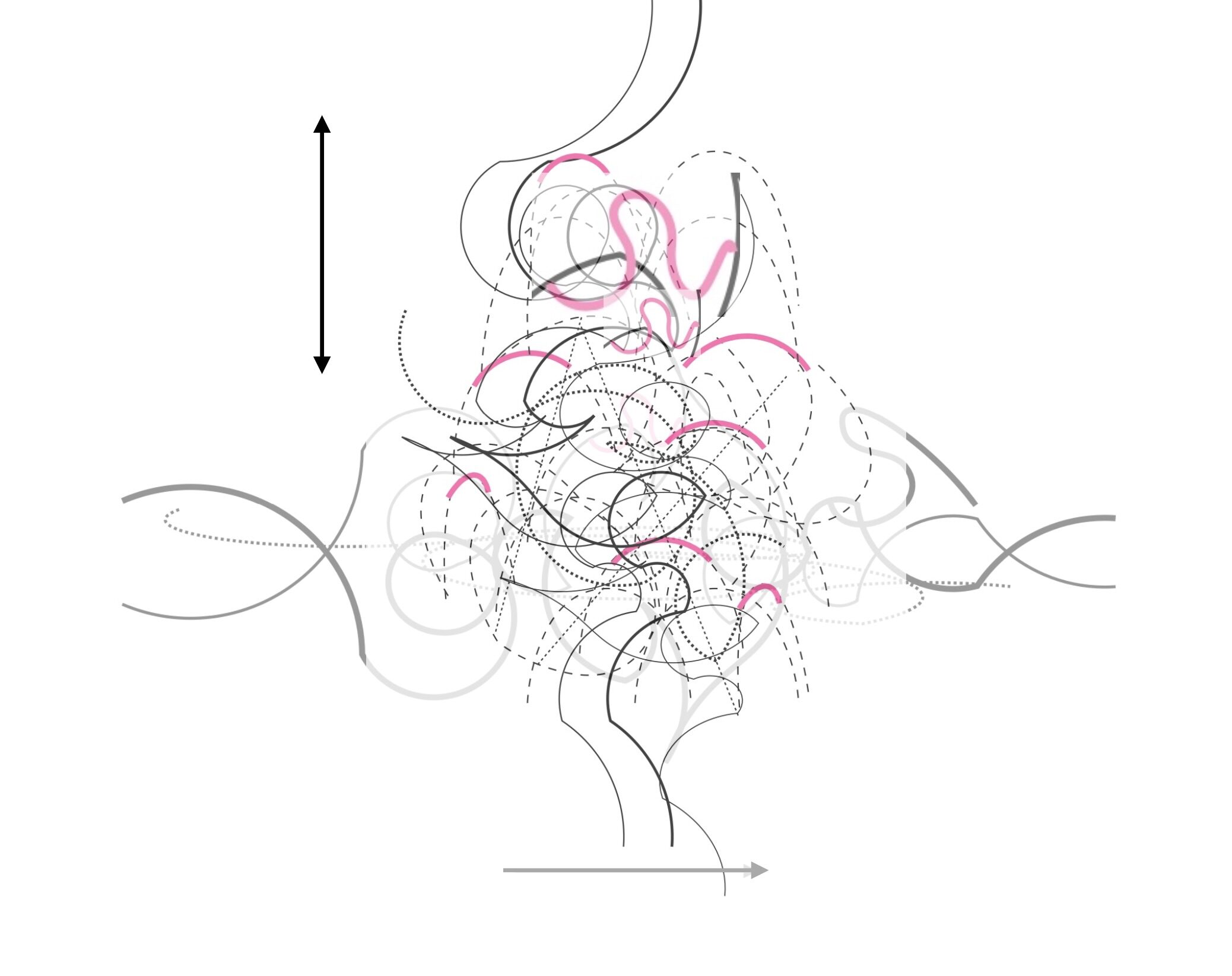
Despite its many virtues, Aristotle’s hylomorphism, when it becomes a shortcut, can obscure the depths and complexity of things. We are accustomed to treating music, for instance, as a combination of matter and form: as the structuring of those specific types of sounds we call musical notes under a more or less regular formal pattern—Fantasia, Toccata, Fugue, Opera, Suite, Concerto, Sonata, Symphony, Étude. Yet each so-called musical form also constitutes a distinct transcendental milieu in which sounds, affects, and experience interplay—where a series of affects that evoke life’s experience because they bear its trace are awakened, disposed in such or such a way, reflected upon, and so forth. Indeed, the idea that they can be reflected upon within a musical piece is fundamental here, as it serves to distinguish popular music from more cultivated forms of music—classical music being precisely that form in which such affects are not merely expressed or experienced, but made available for reflection within the musical domain itself—one should carefully reread Gisèle Brelet’s writings in this respect.(*)
Ernest Ansermet was, however, the first to identify, in 1961, a number of those milieux—which he did not call by that name, though. He did so in a remarkable two-volume essay titled Les Fondements de la musique dans la conscience humaine, where he proposes distinguishing between three ultimate types of milieus—or, in his own terms, “musical projects”—each representing an “act of existence” in its own right. In each of these, a composer’s—and, in no lesser measure, the interpreter’s and the audience’s—affective consciousness explores itself: explores, that is, its own being, its movement, its oscillations—in short, its possibilities. He labels those three distinct “projects” the dramatic, the lyrical, and the epic. Accordingly, Ansermet distributes musical forms as follows: the Fugue and the Sonata belong to the dramatic category, where the affective self combines, in various ways, themes and responses whose contradictions it either organises (the fugue) or resolves (the sonata); Debussy’s La mer, as much as the music of the troubadours—where, despite their obvious differences in form and genre, the direct expression of affective consciousness as such, as displayed in the sonata and the fugue, is instead mediated by an evoked object—would belong to the lyrical category, wherein one could surely place as well the Lied and those once called “pièces de caractère”; finally, as an example of the epic project, he gives the French Suite and, more broadly, the Variation.(**)
I should like to approach here the Suite through a different lens, for I do not think the term “epic” actually defines its revolving around a fundamental idea—at once musical and affective—which is variously explored in each of its “dances” and previously set forth in the “unmeasured prelude” that precedes them. After all, “epic” means pertaining to a poem and/or narrative that unfolds according to a given “line” of action, whereas the Suite rather amounts to a “prism”—or, more precisely, judging from its genealogical connection to the early French lute repertoire, and as I have argued elsewhere (here and here), a fragmented prism.
The prelude already contains the germ of the Suite’s prismatic nature. Consider, for example, this prelude in D minor by the Vieux Gaultier—I reproduce here the original tablature:
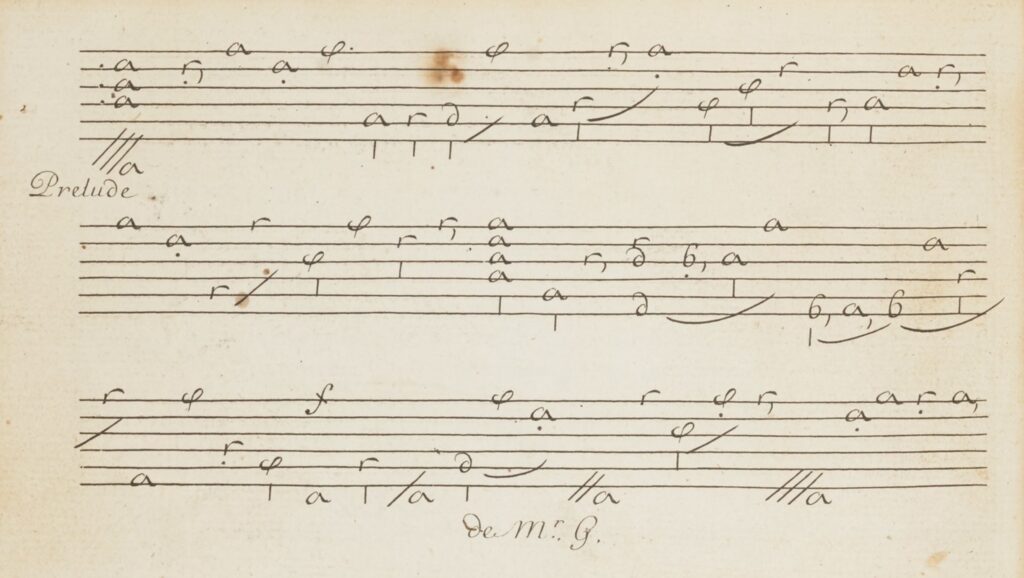
Ninety percent of its notes are instantiations—or else broken, refracted, and delayed echoes—of a tonal triad: the D-minor chord (D–F–A) and its two possible inversions (F–A–D, A–D–F), which thereby behaves like a harmonic object, or crystal, projected through time—an object simple yet, as it were, inexhaustible. Non-existent autonomously, the melody amounts in turn to the continual re-articulation of that object. For their part, the few notes (E, G…) alien to that endlessly reflected, refracted, and delayed harmonic crystal serve either to facilitate its internal transitions (E) or to push its limits by pointing elsewhere (G), without, however, dissolving its identity. And yet the crystal—the prism—is never actually there, since it is infinitely fragmented through the characteristic features of the style brisé, or style luthé!
Moreover, the fact that the prelude is unmeasured makes it akin to a gravitational field susceptible to being freely explored by the interpreter, as if the Vieux Gaultier were saying: “Here is a world” (aside: any world has rules that hold it together, rules and not laws, as Baudrillard reminded Deleuze), “that will provoke in you and in the audience, as much as it provokes in me, certain affects relative to certain experiences we have all lived—in this case, given the minor mode, a severance, an absence, a longing; and while my affects will be neither exactly yours nor those of the public, nor yours exactly mine or the public’s, nor the public’s mine or yours, they will all somehow resonate… Isn’t that what music is ultimately about?”
What about the dances then? The four main dances—Allemande, Courante, Sarabande, Gigue—to which numberless others can be added or intercalated—lead one to contemplate the affective motif in question, in which an experienced state of things thus acquires being—affective being—in different, contrasting ways, asking oneself what it is, that is to say, what facets it presents to us, and how to variously relate to them. Therefore, they put forward what I propose to term an aesthetic ontology of experience: the Allemande, by allowing us to contemplate it as something assumed and assimilated—hence its relatively slow tempo and solemn character; the Courante, by permitting us, nonetheless, to question it further—a Courante’s rapidly coming and going contrapuntal movement being like a prolonged dialogical inquiry; the Sarabande, by making us feel it deeply again, noticing that it still lives within us—hence its slow tempo and emotional character instead; the Gigue, lastly, by bringing it to a close, moving on with agility from it, yet taking something of it with us…
Neither of these occurs in the Sonata, which favours instead a dramatisation of experience through the successive tension and distension of a gestural (melodic) rather than prismatic (harmonic) motif—thus, initially, in Corelli—or through the dialectics of two contrasting motifs—as in the later standardised Sonata form; in the Fugue, whose primary purpose is architectural; in the Concerto, wherein affective experience is rendered in political terms—a solo instrument speaking with and against a community; or in the Étude, where it becomes a matter of free psychological fantazising; whereas the Symphony extends the Sonata to a multitude, the Opera transposes dramatisation into another register, and the Toccata occupies a somewhat intermediary position between the Fantasia and the Prelude, to which the Étude, in turn, looks back obliquely.
Thus, the French Suite’s ontological way of engaging with experience makes of it not just a particular musical form but a distinct aesthetic—and affective—transcendental milieu: a field in which experience does not merely find expression, but acquires a mode of being through the differentiated ways in which it is contemplated, questioned, re-experienced—and finally carried beyond itself—in affective terms. (Transcendental in the sense that it concerns the underlying conditions through which experience becomes intelligible and capable of taking on a determinate mode of appearance.)
(*) See especially Gisèle Brelet, Le temps musical. Essai d’une esthérique nouvelle de la musique (2 vols.; Paris: Presses Universitaires de France, 1949).
(**) Ernest Ansermet, Les Fondements de la musique dans la conscience humaine (2 vols.; Neuchâtel: Éditions de la Baconnière, 1961), vol. 1, pp. 335–43.
N.B. My father’s library included copies of both works—Brelet’s and Ansermet’s. Curiously, and in an entirely different vein, page 71 of the first volume of Brelet’s work may contain an intriguing clue as to why Deleuze wrote on cinema from a Bergsonian standpoint—perhaps in critical tension with, or even against, Brelet’s own Bergsonian aesthetics, which privileged music over cinema. Whilst “[h]earing is the very act of consciousness: an analysis and synthesis oftime, a compound of memory and expectation, the living experience and thought of duration” (p. 69), “[c]inema is the art of the pure image. […] Yet it thereby remains incomplete for a consciousness that aspires to find itself in it and to lend it its own lived duration” (p. 71) writes Brelet. One might well argue that Deleuze’s concept of the time-image is, at least in part, an attempt to overcome precisely this objection.
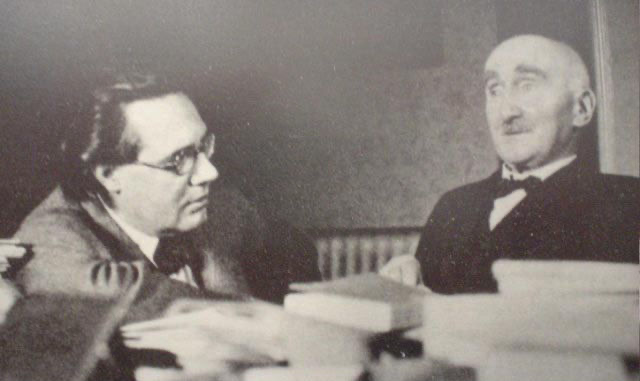
My father with Bergson in Paris, in the 1930s.